White Tea Guide: The Least Processed Chinese Tea
White tea explained: how the least processed Chinese tea is made, its grades from Silver Needle to Shou Mei, how it ages, and how to brew it well.
On this page
White tea is the quietest of the six Chinese teas, and the most misunderstood. It’s often imagined as some rare, ultra-delicate luxury, or wrongly sold as “caffeine-free.” In truth it’s the least processed tea there is — just withered and dried — and that simplicity is its whole character. This guide covers what white tea actually is, how it’s made, its grades from Silver Needle to Shou Mei, why it ages so beautifully, and how to brew it well.
What is white tea?
White tea (白茶, báichá) is a true tea from the Camellia sinensis plant, like green, oolong, and black tea — what sets it apart is how little is done to it. There is no kill-green to halt oxidation and no rolling to bruise the leaf. The freshly picked leaves and buds are simply withered, often over a day or more, and then dried. That’s it.
Because nothing deliberately stops the leaf’s enzymes, a small amount of natural oxidation creeps in during that long wither. So white tea is lightly oxidized rather than truly raw — a common point of confusion. It sits just past green tea on the spectrum from least to most processed, closer to the leaf’s natural state than anything else you can brew.
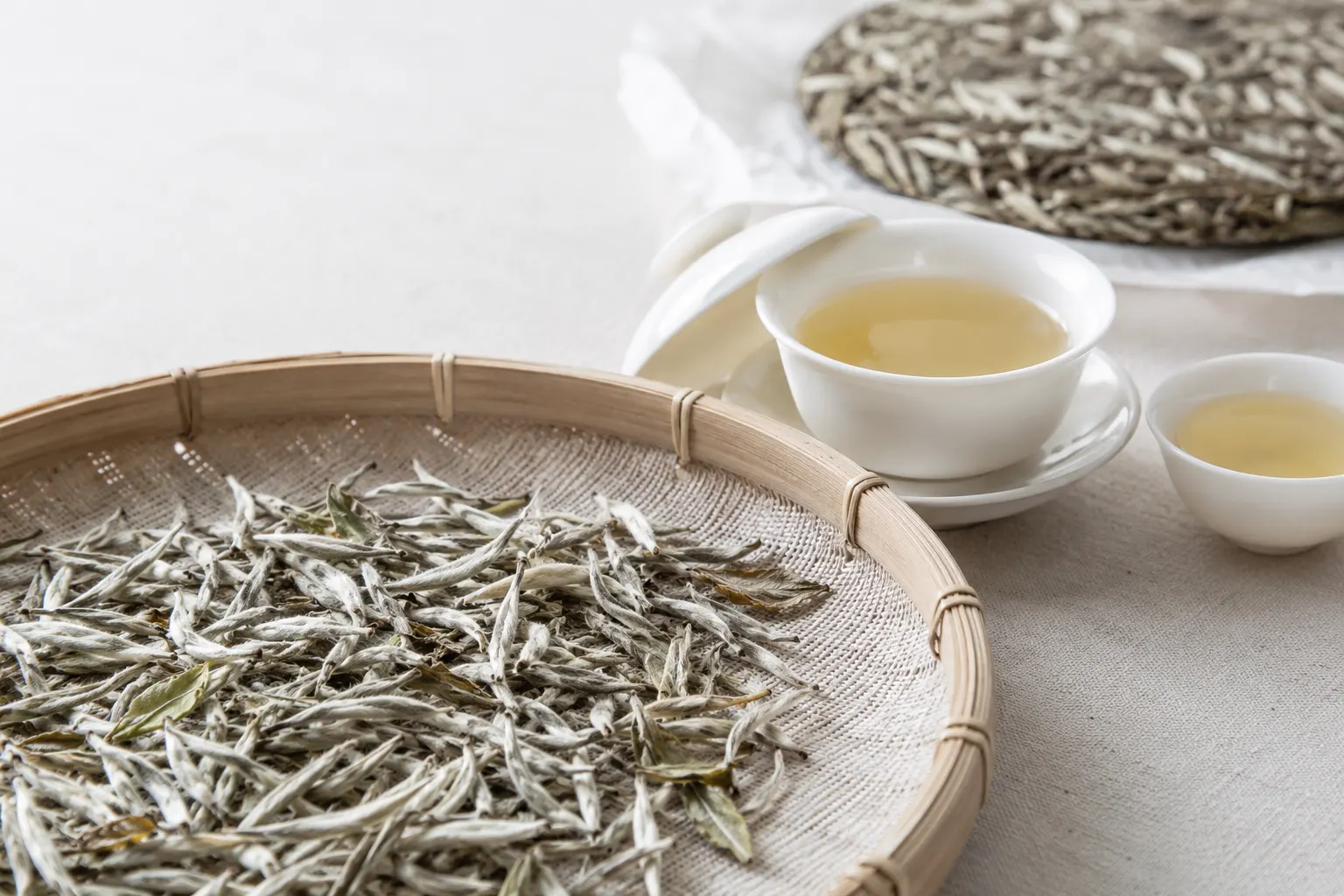
The name comes from the fine silvery-white down (bai hao) that coats the young buds of the best grades, not from the color of the liquor, which brews a pale gold.
Where white tea comes from
White tea is, above all, a Fujian tea. The two heartlands are Fuding and Zhenghe, counties in northeastern Fujian whose tea bushes — especially the plump-budded Da Bai (“big white”) cultivars — are ideally suited to the style. As a defined category, white tea is relatively modern, taking its present shape in Fujian around the Qing dynasty in the nineteenth century, much later than green tea’s ancient lineage.
Today white tea is also made elsewhere — Yunnan produces a robust “moonlight” style (yuè guāng bái) from its big-leaf tea trees, and the method has spread beyond China entirely — but the Fujian classics remain the benchmark.
How white tea is made
The magic of white tea is restraint. Where oolong is shaken, bruised, fixed, rolled, and roasted, white tea has essentially two steps:
- Withering. The leaves are spread out to lose moisture, traditionally in natural air — sun and shade — over a long, slow span. This is where the craft lives: a maker controls temperature, humidity, and timing to coax a gentle, even loss of water and that small touch of natural oxidation, without letting the leaf turn or spoil.
- Drying. A final low-heat drying brings the moisture down to a stable level for keeping.
There is no pan-firing, no bruising, no rolling. That sounds easy, but minimal processing leaves nowhere to hide — withering badly can’t be fixed by a later step, the way a clumsy oxidation can sometimes be salvaged by roasting in oolong. Great white tea is made by judgment, not machinery.
The grades of white tea
White tea is graded mostly by what is picked — all buds, buds with leaves, or mostly leaves — and that single choice shapes the price and the cup.
| Grade | Chinese name | Picked from | Character |
|---|---|---|---|
| Silver Needle | 白毫银针 (Baihao Yinzhen) | Plump unopened buds only | Most delicate, downy, honeyed; the prize |
| White Peony | 白牡丹 (Bai Mudan) | Buds + one or two young leaves | Fuller, fruitier, floral; great value |
| Gong Mei | 贡眉 (Gòng Méi) | Smaller leaves and buds | Bolder, rounder, everyday |
| Shou Mei | 寿眉 (Shòu Méi) | Larger, later-picked leaves | Robust, earthy; ages especially well |
Silver Needle is the icon — made entirely from fat, silvery buds picked over a short spring window, it gives the softest, sweetest, most refined cup and commands the highest price. White Peony adds young leaves to the buds for more body and fruit at a friendlier price, and is many drinkers’ favorite all-rounder. Shou Mei, the leafiest and boldest, is the least expensive fresh — and, pressed into cakes, becomes a favorite for aging.
What white tea tastes like
White tea trades intensity for nuance. Expect a soft, quietly sweet cup — classic notes are hay, melon, honey, and fresh flowers, carried on a downy, almost silky texture. Silver Needle is the most ethereal, all delicacy and sweetness; White Peony brings more fruit and floral lift; Shou Mei is hardier, with a hint of dried herbs.
It’s a tea that rewards attention. Brewed alongside a punchy roasted oolong it can seem faint, but on its own, especially in the morning, its gentle sweetness is exactly the point. Don’t expect a tea that shouts; expect one that hums.
Aging white tea
Here is white tea’s quiet superpower. Unlike most teas, which are best fresh, good white tea — particularly leafier grades pressed into cakes — ages and improves, much as pu-erh does. Stored dry and away from odors, it slowly transforms from fresh, hay-sweet, and floral toward dried fruit, dates, honey, and warm spice, growing deeper and rounder year by year.
A Fuding saying captures the reverence: “one year tea, three years medicine, seven years treasure” (一年茶、三年药、七年宝). It’s a lovely line — though the “medicine” is traditional folklore, not a medical claim. What’s true is that aged white tea becomes a genuinely different, more complex drink, and that pressed cakes of Shou Mei and White Peony are sought out precisely for how they mellow.
To age white tea well, borrow the dark, stable, odor-free side of pu-erh storage — but keep white tea drier and better sealed, since it doesn’t want the humidity and airflow a pu-erh cake wants. Loose white tea ages too, but cakes are denser and more forgiving over the long haul.
How to brew white tea
White tea is forgiving, which makes it a friendly tea to brew. It suits both a relaxed Western steep and the gongfu method; the main thing to get right is the water.
- Temperature. Use around 80–85°C for delicate young white like Silver Needle — boiling water scorches those tender buds and turns a subtle tea harsh. Leafier grades, aged white, and pressed cakes take far more heat, up to near-boiling, and need it to open fully. See the water temperature guide for the full picture.
- Be patient with the buds. Silver Needle is dense and slow to release; give it a little longer than you’d expect, and don’t judge it by the first short steep.
- Gongfu or grandpa style. White tea takes well to many short gongfu infusions, but its forgiving nature also suits “grandpa style” — a generous pinch left loose in a tall glass or mug, simply topped up with hot water as you drink. Few teas are as relaxed.
Aged and pressed white, brewed gongfu with near-boiling water, will give a surprising number of infusions, deepening as it goes.
White tea and caffeine
Let’s bury the myth: white tea is not caffeine-free. It’s a true tea, and it contains caffeine like every other. In fact, because buds concentrate caffeine, an all-bud Silver Needle can carry more than you’d guess — the idea that white is automatically the lowest-caffeine tea doesn’t hold up. As with every tea, what lands in your cup depends far more on how much leaf you use and how long you steep than on the type. If caffeine is the concern, see our guide to Chinese tea for sleep for which teas and habits keep you up — and which don’t.
On the broader health front, white tea is minimally processed, so it retains the polyphenols and antioxidants studied across all teas. The research on tea compounds is generally encouraging but rarely specific to white tea, so it’s best enjoyed for its flavor and gentleness rather than any particular promise.
Buying and storing white tea
A few habits steer you toward good white tea:
- Decide what you want it for. For drinking fresh and bright, buy this year’s Silver Needle or White Peony. For aging, look to pressed cakes of Shou Mei or White Peony, which deepen with time.
- Check the buds. In Silver Needle and White Peony, look for plump, intact buds thick with silvery down, not broken fragments and dust.
- Buy from sellers who name the specifics — Fuding or Zhenghe, the grade, the harvest year — rather than a vague “white tea.”
- Store it dry and sealed, away from light, heat, and strong odors. If you’re aging a cake, it shares the dark, stable, odor-free part of pu-erh storage — but keep white tea drier and more sealed.
Which white tea should you try first?
If you want to taste white tea at its most characteristic, start with a good White Peony — it captures the style’s hay-and-honey softness with enough body to be satisfying, and it’s far gentler on the wallet than Silver Needle. From there, try a Silver Needle to taste the delicate extreme, and a few years of an aged Shou Mei cake to see how dramatically white tea can transform.
Once you’ve found your footing, explore the rest of the six types of Chinese tea, or read up on how to brew any of them well in our brewing guides.
Sources & further reading
- White tea — processing, grades and origins (Wikipedia)
- Tea processing — withering and drying explained (Wikipedia)
- Camellia sinensis — the tea plant behind every true tea (Wikipedia)
- Tea — Encyclopædia Britannica
Researched and reviewed by the Cha Wisdom editorial team. We update our guides when the facts or our recommendations change.
Frequently asked questions
- Is white tea caffeine-free?
- No — that's a common myth. White tea is a true tea from Camellia sinensis and contains caffeine like any other. In fact Silver Needle, made entirely from buds, can be fairly high in it, since buds concentrate caffeine. How much ends up in your cup depends far more on how much leaf you use and how long you steep than on the fact that it's white tea.
- What does white tea taste like?
- Soft and quietly sweet — think hay, melon, and honey, with a downy, almost silky texture. Young white tea is delicate and fresh; aged and pressed white tea deepens toward dried fruit, dates, and warm spice. It's the gentlest of the six tea types, which is exactly its charm.
- What's the difference between Silver Needle and White Peony?
- Silver Needle (Baihao Yinzhen) is made only from plump unopened buds, giving the most delicate, downy, honeyed cup — and the highest price. White Peony (Bai Mudan) blends buds with one or two young leaves, so it's fuller, fruitier, and better value. Shou Mei, made from larger later-picked leaves, is bolder and earthier still.
- Does white tea really get better with age?
- Good white tea, especially pressed cakes, ages well. Stored dry and away from odors, it slowly deepens from fresh and floral toward dried fruit, honey, and warm spice over years. A Fuding saying — 'one year tea, three years medicine, seven years treasure' — captures the reverence for aged white, though the 'medicine' part is folklore, not a health claim.
- What water temperature is best for white tea?
- Around 80–85°C for delicate young white like Silver Needle, which scorches in boiling water. Leafier grades, aged white, and pressed cakes take more heat — up to near-boiling — and reward it with far more flavor. When unsure, start cooler and pour sooner; you can always add heat on the next steep.
Keep reading
- How to Store Pu-erh Tea at Home for Aging
How to store pu-erh tea at home for aging: the right humidity, temperature and air, what to keep it in, mistakes to avoid, and how to spot mold.
- Raw vs Ripe Pu-erh: What's the Difference?
Raw (sheng) vs ripe (shou) pu-erh, explained: how to tell them apart by color, aroma and taste, how each ages, and which one to drink first.
- Wuyi Rock Oolong (Yancha): A Complete Guide
Wuyi rock oolong, or yancha, explained: rock rhyme, cliff-grown terroir, Da Hong Pao, Rou Gui and Shui Xian, charcoal roasting, and how to brew it.