How to Brew Gongfu Tea Step by Step
A step-by-step walkthrough of brewing gongfu tea — warming, rinsing, pouring, decanting and re-steeping — with timings and sensory cues for every move.
On this page
This is the part where gongfu tea actually happens: the sequence of small, deliberate moves that turn a pile of leaves and a kettle into a dozen cups. If you’re still gathering gear or wondering what “gongfu” even means, start with our complete beginner’s guide to gongfu tea — this article picks up where that one leaves off and walks through the brewing process itself, one step at a time, with the reasoning and the sensory cues behind each move.
Before you start: a 30-second setup
Have everything within reach before the water boils, because once you begin, gongfu moves quickly. You’ll want your gaiwan (or small teapot), a pitcher, your cups, the tea, and hot water at the right temperature.
Two numbers decide most of the outcome, and both have a dedicated guide so we won’t re-teach them here:
- Leaf-to-water ratio — roughly 1 gram of leaf per 15 ml of water to start. The full breakdown by gaiwan size is in the gongfu guide.
- Water temperature — cooler for delicate teas, near-boiling for robust ones. See the water temperature guide for the chart and how to hit each temperature without a thermometer.
Get those roughly right, then follow the steps below. The technique is the same whatever you’re brewing; only the dials shift by tea type.
Step 1 — Warm the vessel (and the rest)
Pour hot water into the empty gaiwan, swirl it, and tip it out — into the pitcher and cups so they warm too, then discard. This isn’t a formality. A cold vessel robs heat from your first infusion the instant you pour, and your opening cup brews cooler than you intended. Warming also dries any musty note from a pot that’s been sitting on the shelf.
It takes ten seconds and it makes the first cup — often the one people judge a tea by — taste the way it should.
Step 2 — Add the leaf and smell it
Measure your leaf into the warm, empty gaiwan, put the lid on, and give it a few seconds. The residual heat lifts the dry aroma, so lift the lid and breathe in. This “warmed dry leaf” sniff tells you a lot before a drop of water touches the tea — a good roasted oolong smells of toasted nuts and dark sugar; a fresh green smells sweet and grassy; pu-erh turns earthy and deep.
It’s also your first quality check. A flat, papery, or sour smell here is a sign of stale or poorly stored tea, and no brewing technique will fully rescue it.
Step 3 — Rinse (for the teas that want it)
For oolong, pu-erh, dark tea, and most rolled or aged leaves, pour in hot water, then immediately pour it all back out and discard it — a five-second rinse, no soaking. People call it “washing the tea,” but its real job is to wake the leaf: warming and loosening tightly rolled or compressed leaves so they’re ready to give their best from the first real infusion. Ripe and aged pu-erh often get two quick rinses.
Skip the rinse for delicate teas — green, yellow, and young white. They open readily, give only a handful of infusions, and a rinse would simply pour away some of the best of a short-lived tea. (More on which is which in the six types of Chinese tea.)
Step 4 — The first infusion: pour, time, watch
Now the real thing. Pour your hot water in a steady stream around the inside edge of the gaiwan rather than blasting straight onto the leaves — it bathes them more evenly and stirs them into a gentle turn. Fill to just below the rim, set the lid on at a slight angle to leave a venting gap, and start counting.
Keep the first proper steep short — on the order of 10–20 seconds for most teas, a little less for delicate greens. While it steeps, watch the leaves: rolled oolong begins to loosen, compressed pu-erh starts to separate, a green tea’s buds sink and stand. These cues matter more than a stopwatch once you’ve brewed a tea a few times. When in doubt, pour sooner — a short steep you can always lengthen, but you can’t take bitterness back out of a cup.
Step 5 — Decant completely, to the last drop
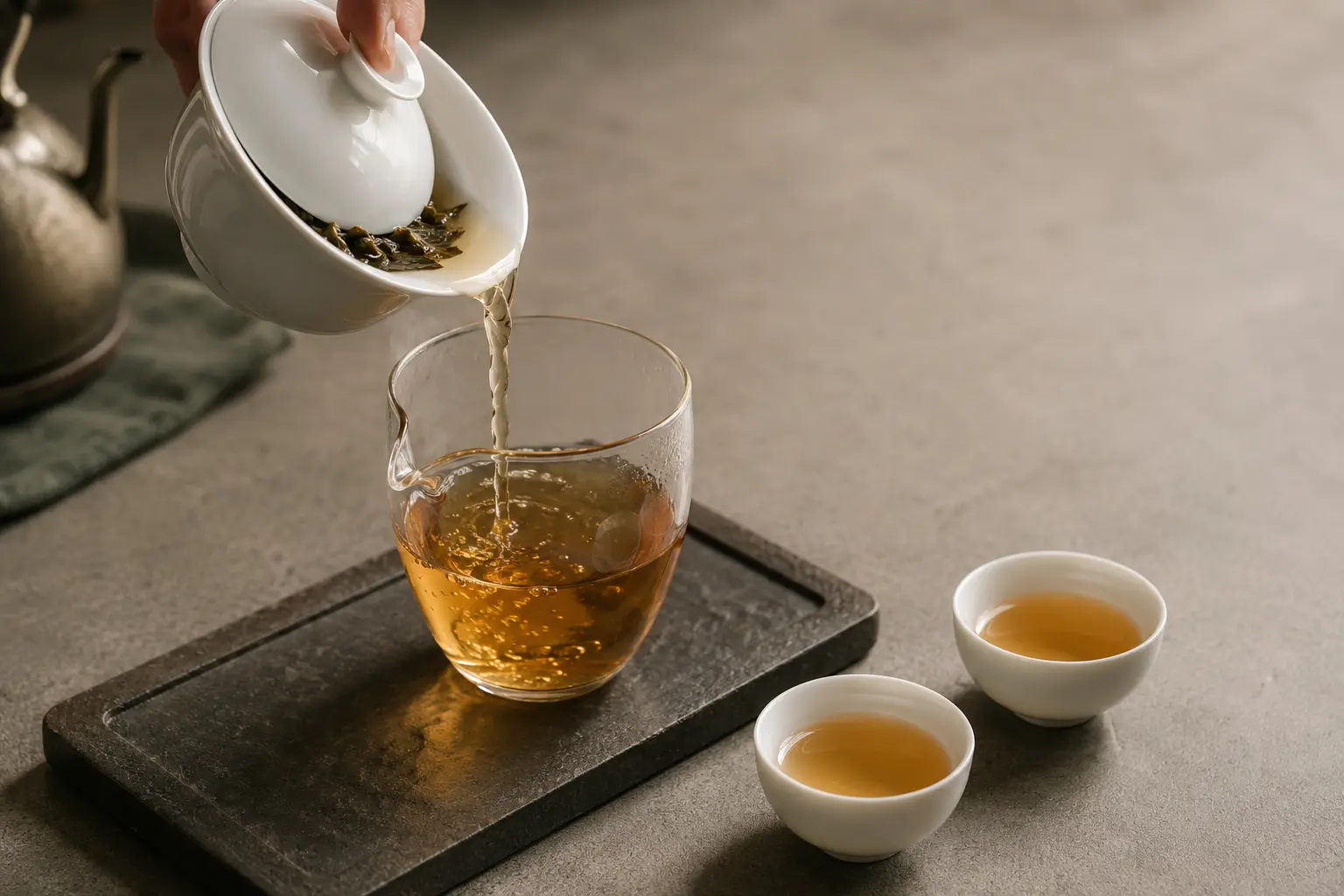
This is the single most important habit in gongfu brewing. When the time is up, pour the entire contents of the gaiwan into your pitcher — all of it, down to the last drip, with the gaiwan tipped fully vertical for a second or two at the end.
Why it’s non-negotiable: any liquor left behind keeps steeping the leaves between rounds. Leave a centimetre in the bottom and your next infusion starts out stewed and bitter before you’ve added fresh water. Full separation of liquor from leaf is exactly what lets you steep short and re-steep many times — the whole point of the method.
To hold a hot gaiwan: thumb and middle finger on opposite edges of the wide rim, index finger pressing the lid knob, the lid shifted to leave a narrow slot the tea streams through while the leaves stay put. Your fingers rest on the cool rim and base, never the scalding wall. Pour in one confident motion — a slow dribble both burns your fingers and over-steeps the dregs.
Step 6 — Pour from the pitcher into the cups
Pour from the pitcher into the cups, not from the gaiwan directly. The pitcher — the cha hai, literally “tea sea” — earns its place here: a gaiwan poured straight into a row of cups fills the first cup weak and the last over-steeped, but decanting everything into the pitcher first blends it to one even strength, so every cup tastes the same. Fill the cups only two-thirds full; gongfu cups are small on purpose, meant to be drained warm and refilled often.
Brewing just for yourself? You can pour straight into a single cup and skip the pitcher — its job is fairness across multiple cups.
Step 7 — Taste, and read the cup
Drink it warm, in a sip or two, and pay attention — the cup is your instructions for the next steep:
- Bitter or harsh? Steep was too long, water too hot, or too much leaf. Pour sooner next round, or ease the temperature.
- Thin and watery? Too little leaf, or water not hot enough for the style. Hold the next steep a little longer, and add leaf next session.
- Just right? Repeat what you did, adding only a few seconds as the leaves tire.
This feedback loop — taste, adjust, taste again — is the skill that “gongfu” refers to. Two or three sessions with the same tea and you’ll stop counting seconds and start reading the leaf.
Step 8 — Re-steep until the leaves give out
Now repeat steps 4 through 7, adding time as you go. Because the leaves slowly exhaust, each infusion needs a touch longer than the last to keep the strength up. A typical curve for a rolled oolong looks like this — treat it as a starting point, not a rule:
| Infusion | Steep time | What’s happening |
|---|---|---|
| Rinse | 5s (discard) | Waking the rolled leaf |
| 1st | 15–20s | Leaf still opening; cup is light |
| 2nd | 15s | Leaf open, often the strongest cup |
| 3rd | 20s | Peak flavour for many oolongs |
| 4th | 30s | Holding steady |
| 5th | 40s | Starting to thin |
| 6th+ | +15s each | Stretch each steep as it fades |
Notice it isn’t a straight climb: the second and third infusions can be the best of the session, especially for rolled oolongs that need a round or two to fully unfurl. Quality oolong and pu-erh run to eight, ten, or more infusions; a delicate green gives three to five and then politely quits. The leaves are done when a longer, hotter steep still comes out pale and flavourless — that’s your cue to stop, not a reason to push harder.
A full session, start to finish
Here’s the whole sequence for one real tea — a rolled oolong such as a Taiwanese high-mountain or a Wuyi rock oolong — so you can see how the steps connect:
- Boil water; pour some into the gaiwan, pitcher, and cups to warm them, then discard.
- Add about 6–7 g of leaf to a 100 ml gaiwan. Lid on; smell the warmed dry leaf.
- Rinse: fill, then immediately pour out and discard.
- First infusion at ~95°C, around 15–20 seconds.
- Decant every drop into the pitcher.
- Pour from the pitcher into the cups.
- Taste. Adjust the next steep to what the cup told you.
- Re-steep, adding a few seconds each round, for eight or more cups.
Total active time per cup: under a minute. The rhythm — pour, count, decant, serve, taste — becomes meditative fast.
Mistakes that show up in the pour
The gongfu guide covers the big-picture beginner errors; these are the ones specific to executing the steps:
- Leaving liquor in the gaiwan. The number-one cause of a good first cup followed by bitter ones. Empty it completely, every single time.
- Pouring slowly. A timid trickle over-steeps the dregs and scalds your fingers. Commit to one smooth pour.
- Steeping by the clock, not the cup. Timings are a starting point. A tea you know is read by eye and tongue, not a stopwatch.
- Judging a tea by the first infusion. Many teas, rolled oolong above all, only hit their stride on the second or third steep. Give it a few rounds.
- Letting the water go cold between steeps. Later infusions need the heat held; a brew that drifts from 95°C to 80°C by the fifth cup tastes increasingly thin.
Where to go next
You now have the full process. To go deeper, dial in the two variables that change everything — the water temperature for each tea type, and your brewing vessel, where our gaiwan vs Yixing teapot comparison helps you choose. Or explore the individual tea types to learn what you’re brewing, and the rest of our brewing guides for technique.
Sources & further reading
- Chinese tea culture — gongfu brewing within the broader tradition (Wikipedia)
- Gongfu tea ceremony — the method and its vessels (Wikipedia)
- Tea — brewing and extraction (Encyclopædia Britannica)
Researched and reviewed by the Cha Wisdom editorial team. Timings and ratios reflect common gongfu practice and are starting points to adjust to taste; we update our guides when the facts or our recommendations change.
Frequently asked questions
- How long should each gongfu steep be?
- Start short. For most oolong and pu-erh, the first proper infusion runs about 10–20 seconds; greens and whites a touch less. Then add a few seconds to each successive steep as the leaves tire. It's a curve, not a fixed number — taste each cup and let it tell you whether to pour sooner or wait longer next round.
- Do I need to rinse the leaves before brewing?
- Rinse oolong, pu-erh, dark tea and most aged or rolled leaves: a quick 5-second pour of hot water that you discard immediately. It wakes and warms the leaf rather than washing it. Skip the rinse for delicate green, yellow and young white tea — you'd only pour away the best of a tea that gives just a few infusions.
- Why pour the tea into a pitcher instead of straight into the cups?
- The pitcher (cha hai) does two jobs: it stops the steep instantly by separating liquor from leaf, and it evens out the strength so every cup tastes the same. Pouring directly into several cups leaves the first weak and the last over-steeped. If you're brewing for one, you can pour straight into a single cup.
- How do I hold a hot gaiwan without burning my fingers?
- Use the lid to hold back the leaves and keep your fingers on the cool rim and base, not the hot wall. Thumb and middle finger on opposite edges of the saucer-like rim, index finger on the lid knob. Pour in one confident motion rather than a slow trickle. A smaller gaiwan and a little practice make this second nature.
Keep reading
- Chinese Tea Ceremony: History, Meaning & How It Works
Explore gongfu tea hospitality: what happens at the tea table, guest etiquette, and the history behind it, with distinctions from wedding and Japanese tea rites.
- Gaiwan vs Yixing Teapot: Which Should You Start With?
Gaiwan or Yixing teapot for your first gongfu setup? A clear, practical comparison of cost, versatility, and which teas each one brews best.
- Water Temperature Guide for Every Chinese Tea Type
The right water temperature for green, white, oolong, black and pu-erh tea — a complete chart, why it matters, and how to hit it without a thermometer.