Chinese Tea Ceremony: History, Meaning & How It Works
Chinese tea ceremony can describe different customs. This guide focuses on gongfu cha: preparing loose-leaf tea in small vessels, sharing short infusions, and welcoming guests. Wedding tea ceremonies have a different purpose, and etiquette varies by region and host.
See the tea-table sequence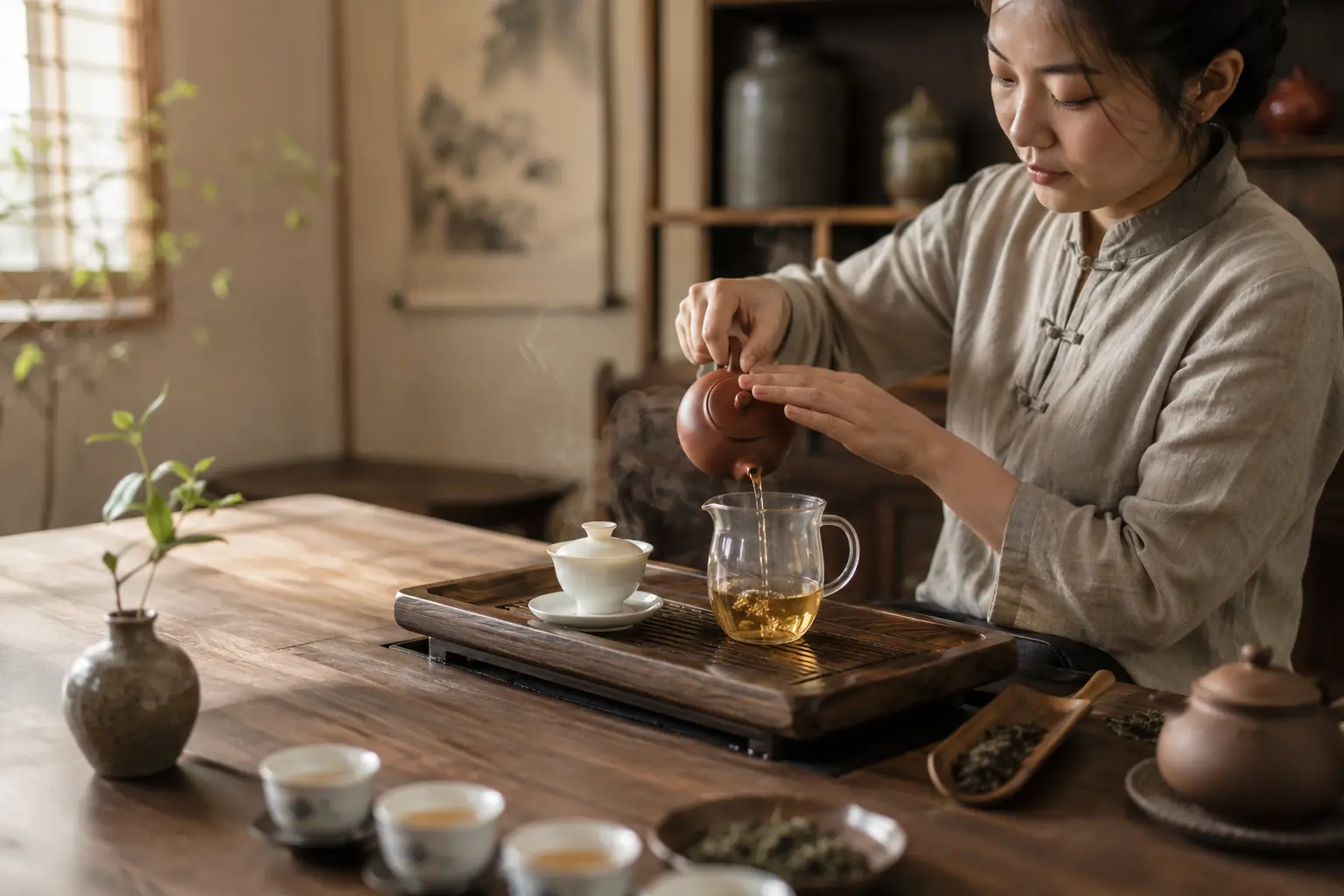
On this page
A Chinese tea ceremony is not a single activity with one set of rules. This guide focuses on gongfu cha as hospitality: what a host does, how guests can participate, and the history behind the small cups and repeated infusions. Wedding tea rites and formal tea-art presentations are related parts of tea culture, but they are not interchangeable with an everyday gongfu gathering.
What “Chinese tea ceremony” really means
It helps to distinguish three contexts:
| Context | Main purpose | What to expect |
|---|---|---|
| Gongfu tea gathering | Brewing and sharing tea with care | Small vessels, repeated infusions, tasting, and conversation |
| Tea-art presentation (cha yi, 茶艺) | Demonstrating preparation and presentation skills | A sequence that may be rehearsed or formalized for the setting |
| Wedding tea rite | Honoring parents and elders within a marriage celebration | Serving tea according to family and regional customs, rather than a gongfu tasting sequence |
These contexts can overlap, but they answer different questions. If you are attending a wedding, ask the couple or family about the order and customs. The sequence below is for a gongfu tea table, not a wedding checklist.
For choosing equipment and understanding brewing ratios, start with the gongfu beginner’s guide. For a detailed pouring and steeping walkthrough, use how to brew gongfu tea. Here, the emphasis is on sharing tea and participating as a guest.
How a Chinese tea ceremony works
A typical contemporary gongfu gathering might follow this sequence. It is an example, not a required script: regional traditions, teaware, and hosts differ.
- Set out the tea and vessels. The host prepares a gaiwan or small teapot, drinking cups, and often a pitcher. A draining tray is convenient but not essential.
- Warm the vessels and introduce the tea. The host may offer the dry leaves for guests to smell and describe where the tea comes from. Watch how the host handles the vessels, and ask before picking up someone else’s teaware.
- Brew a short infusion. The host adjusts the water and steeping time to the leaves, then drains the brewing vessel. A pitcher helps distribute an even strength; some traditions pour directly into the cups in a controlled sequence.
- Serve the guests. The order may reflect age, status, or the occasion. Follow the host’s lead rather than assuming one serving order applies everywhere. Hot tea is offered for drinking, not for finishing as quickly as possible.
- Taste and repeat. Let the tea cool enough to sip comfortably. Notice how the aroma and taste change over successive infusions, and share observations without feeling that there is a correct tasting answer.
A session does not need a fixed number of rounds. Tell the host when you have had enough, especially if you are limiting caffeine. Accepting hospitality does not require drinking beyond your comfort.
Etiquette and gestures
A little attentiveness matters more than memorizing a performance:
- Thank the person pouring. A spoken thank-you is enough. In some settings, guests lightly tap fingers on the table as a silent acknowledgment. The number of fingers and the gesture vary. The story linking this to the Qianlong Emperor is a popular legend, not an established historical origin.
- Receive tea with care. Supporting a cup with both hands can show respect, but handle hot cups safely and follow the local setting. Ask before moving teaware or helping with the pouring.
- Treat aroma cups as optional. Some Taiwanese-style setups pair a tall smelling cup with a drinking cup; many tea tables do not use one. The host can demonstrate it if it is unfamiliar.
- Let the host manage the table. Preferences about spout direction, serving order, and refills vary. Observe or ask instead of assuming a universal rule.
- Say when you are finished. A polite decline or request for a smaller serving is preferable to feeling obliged to keep drinking.
Formal demonstrations may have prescribed movements, while a gathering at home may be conversational. Neither setting represents all Chinese tea practice.
A short history of tea ritual in China
Tea preparation has changed over time. The following periods offer useful landmarks, not a claim that each new method instantly replaced every older one.
Tang dynasty: Lu Yu and the Classic of Tea
Lu Yu (陆羽, 733–804) wrote The Classic of Tea (《茶经》, Cha Jing) in the 8th century, an early systematic work on tea, its tools, preparation, and appreciation. His influence earned him the name “Sage of Tea.”
The preparation described in this tradition differs from today’s gongfu brewing: cake tea could be roasted, ground, and boiled, with attention to water and utensils. It is part of the history of tea culture, not a description of a modern gaiwan session.
Song dynasty: whisked tea and tea contests
During the Song dynasty (960–1279), whisking powdered tea in a bowl became an important practice, known as diancha (点茶). Tea contests (doucha, 斗茶) valued features such as the appearance and persistence of the foam. Dark Jian tea bowls provided a contrasting background for the pale whisked tea.
Buddhist and other cultural exchanges helped carry powdered-tea practices and Chinese tea vessels to Japan. Japanese matcha traditions developed through their own later history; they should not be described as an unchanged copy of a Song practice, nor confused with loose-leaf gongfu brewing.
Ming dynasty: the loose-leaf revolution
Loose-leaf steeping became increasingly prominent during the Ming dynasty (1368–1644), alongside the use of teapots. The Hongwu Emperor’s preference for leaf tea as tribute rather than compressed cakes is one landmark in accounts of this shift.
A change in imperial tribute requirements is not the same as a ban on all cake tea or the invention of every modern brewing method. Practices developed over time and varied by place; compressed tea also continued to have a history of its own.
The rise of gongfu cha
Gongfu cha is closely associated with Chaoshan in Guangdong and with Fujian’s tea traditions, particularly oolong. Accounts differ about its precise beginnings, so it is more useful to recognize these regional connections than to assign one uncontested birthplace or date.
The Guangdong Department of Culture and Tourism records that Chaozhou gongfu tea art entered China’s national intangible cultural heritage list in 2008. It was also one component of the wider Traditional tea processing techniques and associated social practices in China inscribed on UNESCO’s Representative List in 2022. That recognition covers a range of tea-making skills and customs, not a single standardized national tea ceremony.
The meaning behind the cup
Hospitality, attention to the tea, and respect for others are useful ways to understand a tea gathering. Writers also discuss tea through Daoist ideas of nature, Confucian ideas of social respect, and Chan Buddhist practices of attention. These are interpretive traditions, not beliefs that every host must hold or a philosophical test a guest needs to pass.
For one household, tea may be an everyday way to welcome a visitor. For another setting, it may be a formal presentation or an occasion for quiet tasting. The meaning comes partly from the people and occasion, not only from the movements of brewing.
Chinese vs Japanese tea ceremony
Gongfu cha commonly uses loose-leaf tea, small brewing vessels, and repeated short infusions. Japanese chanoyu centers on preparing and serving powdered matcha, with procedures developed within particular schools and traditions. The Britannica account of chanoyu also emphasizes welcoming guests, aesthetics, and the setting of the gathering.
Both can involve hospitality, careful preparation, and trained technique. Chinese tea-art presentations can be highly structured, and Japanese tea occasions differ in scale and formality. Calling one culture “relaxed” and the other “rigid” obscures those differences. Compare a particular gongfu gathering with a particular chanoyu occasion, not all tea drinking in two countries.
The ceremony today
Gongfu brewing is practiced in homes, teahouses, teaching settings, and tea communities beyond its regional centers. A contemporary tea table may use a porcelain gaiwan and pitcher, while a regional demonstration may present a more specific set of utensils and movements.
This variety is part of a living tradition. As a guest, asking what the host is brewing and how they like to serve it is more useful than expecting every tea table to follow the same ceremony.
The short version
Chinese tea ceremony is an umbrella phrase, not one universal rite. For a gongfu gathering, expect an introduction to the tea, warming and brewing, serving, and repeated tastings. Thank the host, handle hot cups carefully, and ask about customs you do not know. Wedding tea rites and formal presentations have their own contexts.
The history adds depth, but you do not need to master it before sharing a cup. Begin with the gongfu equipment and brewing guide, or follow the step-by-step brewing walkthrough.
Sources & further reading
- Gongfu tea — brewing practice, regional history, and variations in equipment (Wikipedia)
- Chinese marriage — context for wedding customs and serving tea to family (Wikipedia)
- Lu Yu and The Classic of Tea — background on the author and his work (Wikipedia)
- Jian ware — Song tea bowls, whisked tea, and changing Ming preferences (Wikipedia)
- Tea ceremony — Japanese chanoyu, hospitality, and its setting (Encyclopædia Britannica)
- Chaozhou gongfu tea art and the 2022 UNESCO inscription — the 2008 national listing and participation in the wider inscription (Guangdong Department of Culture and Tourism; Chinese)
- Traditional tea processing techniques and associated social practices in China — the wider UNESCO heritage entry
This guide describes gongfu hospitality rather than a universal set of Chinese tea rules. Regional and family customs vary. Historical interpretations and popular legends are distinguished where relevant; we update the guide when the sources or our understanding change.
Frequently asked questions
- What is the Chinese tea ceremony?
- The English phrase can describe several customs, including gongfu tea hospitality, tea-art presentations, and wedding tea rites. This guide focuses on gongfu cha: brewing loose-leaf tea in small vessels and sharing repeated short infusions. It is not one universal ceremony with rules followed by every Chinese household.
- Is the Chinese tea ceremony the same as the Japanese one?
- No. Gongfu cha commonly uses loose-leaf tea and repeated short infusions. Japanese chanoyu centers on preparing and serving powdered matcha and has school-specific procedures. Both can express hospitality and care; their formality depends on the setting and tradition, so a simple relaxed-versus-rigid comparison is misleading.
- What is gongfu cha?
- Gongfu cha means preparing tea with skill and care, commonly using a high leaf-to-water ratio, small vessels, and repeated short steeps. It is closely associated with Chaoshan in Guangdong and with Fujian tea traditions, and is practiced more widely today. It is a brewing and serving approach, not a synonym for every Chinese tea ritual.
- Why do people tap the table during a tea ceremony?
- In some Chinese tea-table settings, lightly tapping fingers on the table is a silent thank-you to the person pouring. A popular story connects it to the Qianlong Emperor traveling in disguise, but that is a legend, not a verified origin. The gesture and number of fingers vary; follow your host or simply say thank you.
- Do I need special equipment for a Chinese tea ceremony?
- For a simple gongfu gathering, a small teapot or gaiwan and drinking cups are enough to begin; a pitcher makes it easier to share tea of even strength. Trays and aroma cups are optional, and traditional setups vary. Wedding tea rites follow family customs rather than a standard gongfu equipment list.
Keep reading
- The Complete Beginner's Guide to Gongfu Tea
Learn how to brew gongfu tea step by step, from choosing your first gaiwan to mastering steeping times. The most practical English guide online.
- How to Brew Gongfu Tea Step by Step
A step-by-step walkthrough of brewing gongfu tea — warming, rinsing, pouring, decanting and re-steeping — with timings and sensory cues for every move.
- Gaiwan vs Yixing Teapot: Which Should You Start With?
Gaiwan or Yixing teapot for your first gongfu setup? A clear, practical comparison of cost, versatility, and which teas each one brews best.