The Complete Beginner's Guide to Gongfu Tea
Learn how to brew gongfu tea step by step, from choosing your first gaiwan to mastering steeping times. The most practical English guide online.
On this page
Gongfu tea (功夫茶) is the Chinese method of brewing tea with a high leaf-to-water ratio and many short infusions. Instead of one long steep, you coax a dozen small cups out of the same leaves — and each one tastes a little different. This guide walks you through everything you need to start, with no jargon and no expensive gear required.
What “gongfu” actually means
The word gongfu means skill earned through practice. Applied to tea, it describes brewing attentively: more leaf, less water, and precise control over time and temperature. The payoff is a fuller, more layered cup than the single-bag-in-a-mug approach ever delivers.
What you need to start
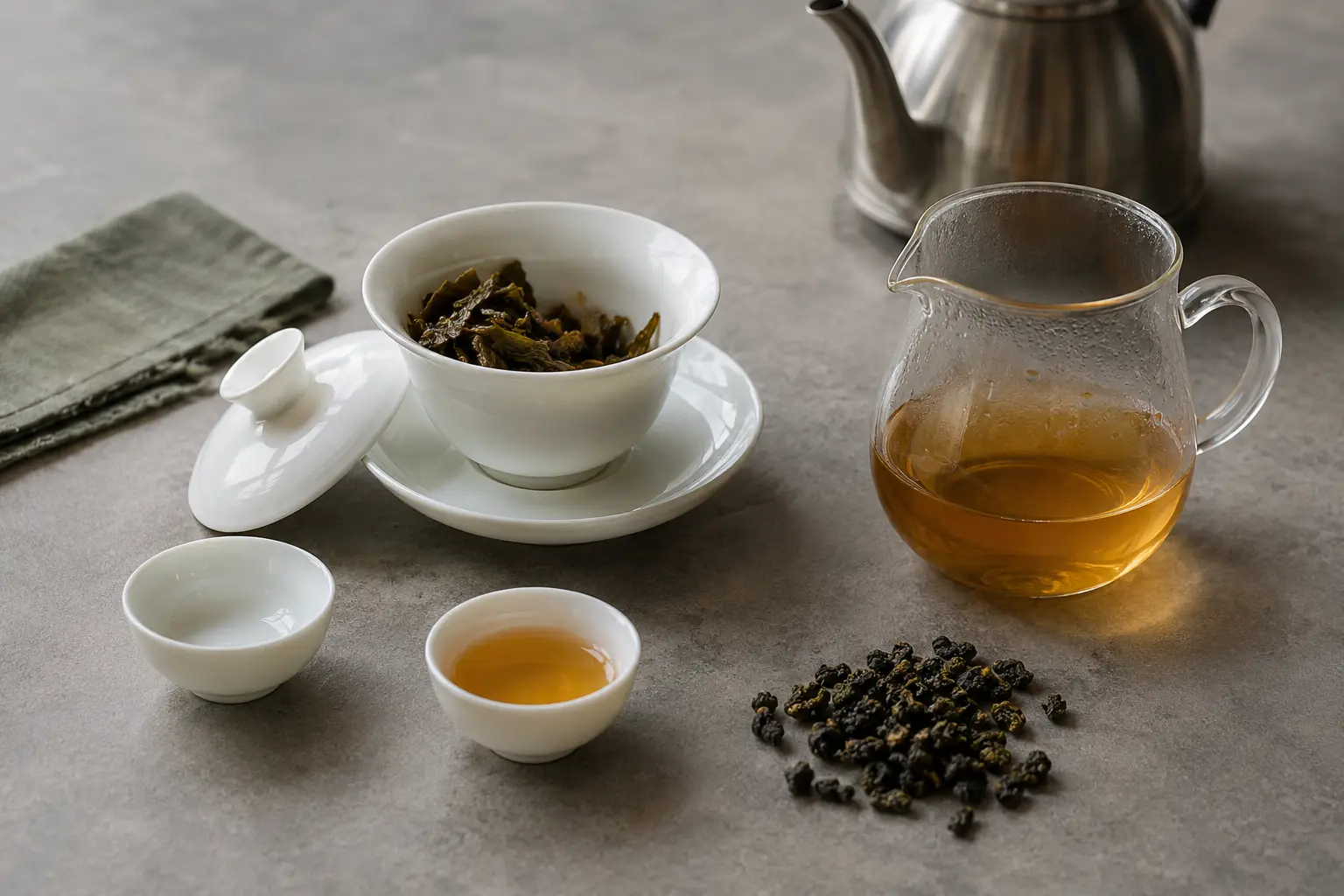
You can begin with a surprisingly small kit:
- A gaiwan — a lidded bowl, usually 100–150 ml. The most versatile brewing vessel for beginners.
- A pitcher (cha hai) — to pour off the brew evenly and stop the steep.
- Two small cups — gongfu cups are small on purpose.
- A scale and a kettle with temperature control (optional but helpful).
If you’re still deciding between a gaiwan and a clay teapot, the gaiwan wins for learning — it’s neutral, easy to clean, and lets you taste the tea honestly. Our gaiwan vs Yixing teapot comparison walks through the trade-offs in full.
No special gear? Easy substitutes
You can taste the gongfu difference today with things already in your kitchen. The method is about ratio and rhythm, not equipment.
- No gaiwan? Any small lidded vessel works — even a mug with a saucer held over the top to hold back the leaves as you pour. A small French press will do in a pinch: add the leaf, pour, and press just enough to strain each short infusion off the leaves.
- No pitcher? Pour straight into your cup, or into a second mug. The pitcher only exists to stop the steep and even out the brew — a fast, complete pour does the same job.
- No scale? Eyeball it. A rough guide: cover the bottom of the vessel with leaf for strip teas, or a thin single layer for rolled oolong and broken pu-erh. You’ll calibrate by taste within a session or two.
- No temperature kettle? Boil, then wait. Off the boil, water drops roughly 5°C a minute in an open vessel, so for a green tea you want around 80°C, let a freshly boiled kettle stand three to four minutes before pouring.
None of these are compromises you’ll feel much as a beginner. Upgrade to a real gaiwan when you’re hooked, not before.
Water temperature by tea type
Temperature matters more than almost anything else. Too hot and a delicate green turns bitter; too cool and a roasted oolong never opens up. Use this as a starting point:
| Tea type | Water temperature | First steep |
|---|---|---|
| Green | 75–80°C | 15–20s |
| White | 80–85°C | 20–30s |
| Oolong (light) | 90–95°C | 20–25s |
| Oolong (roasted) | 95–100°C | 15–20s |
| Pu-erh (ripe) | 100°C | 10–15s |
For the full breakdown — every tea type, the reasoning, and how to hit each temperature without a thermometer — see our water temperature guide.
How much leaf: ratios by gaiwan size
The other half of the method is the leaf-to-water ratio. Western brewing uses roughly 1 gram per 60–80 ml; gongfu uses far more — about 1 gram per 15 ml as a starting point. More leaf in less water is exactly what lets you steep short and re-steep many times. Match the leaf to your vessel:
| Gaiwan size | Lighter (≈1g / 20ml) | Standard (≈1g / 15ml) | Stronger (≈1g / 12ml) |
|---|---|---|---|
| 100 ml | 5 g | 6–7 g | 8 g |
| 120 ml | 6 g | 8 g | 10 g |
| 150 ml | 7–8 g | 10 g | 12 g |
Start in the middle column and adjust to taste. If a tea comes out harsh, use a little less leaf or shorter steeps next time; if it’s thin and watery, add leaf rather than steeping longer — long steeps pull out bitterness, more leaf adds body.
How to brew, step by step
- Warm the gaiwan with hot water, then discard it.
- Add the leaf — about 1g per 15ml of water.
- Rinse (for oolong and pu-erh): a quick 5-second pour, then discard.
- First infusion: pour water in, steep for the time above, decant fully into your pitcher.
- Serve into cups and taste.
- Re-steep, adding a few seconds each round, until the leaves give out.
The key habit: pour the gaiwan completely empty every time. Leftover water keeps steeping and turns the next cup bitter. For the full walkthrough — every step, the pouring technique, and a re-steep timing schedule — see how to brew gongfu tea step by step.
Adjusting for different teas
The steps above are universal; the dials change a little by tea type.
- Green and yellow — the most delicate. Use cooler water (75–80°C), skip the rinse, and keep steeps short. These give fewer infusions, usually three to five, before they fade.
- White — forgiving. A touch hotter than green; light whites are fragile, but aged and pressed whites take near-boiling water and many steeps.
- Oolong — the gongfu classic. Always rinse rolled and roasted styles to wake the leaf. Rolled oolongs unfurl slowly, so don’t judge the first cup — they often peak around the third and run to ten or more.
- Black (red) tea — around 90°C; steep on the short side, as Chinese blacks can turn astringent if pushed. Expect a generous handful of infusions.
- Pu-erh and dark tea — near-boiling water and a rinse (two for ripe or aged cakes). These are the marathon runners: ten-plus infusions are normal.
When in doubt, cooler and shorter is the safer error — you can always add heat and time on the next steep, but you can’t take bitterness back out of a cup.
Common beginner mistakes
Most early disappointments come down to a handful of habits:
- Not emptying the gaiwan. Leftover liquor keeps brewing between rounds and stews the next cup. Pour to the last drop, every time.
- Steeping too long to make it “stronger.” Long steeps extract bitterness, not body. For a stronger cup, use more leaf, not more time.
- Water too hot for delicate teas. Boiling water scorches green and light oolong. Let it cool first.
- Too little leaf. Western-sized pinches make a thin, forgettable gongfu cup. Be generous; this is the whole point of the method.
- Giving up after one infusion. The first cup is rarely the best. Many teas, rolled oolong especially, only hit their stride by the second or third steep.
Troubleshooting: why your cup tastes off
A quick diagnostic when something’s not right:
- Bitter or harsh? Water too hot, steep too long, or too much leaf. Cool the water, pour sooner, or use slightly less leaf.
- Thin and watery? Too little leaf, or water not hot enough for the style. Add leaf and check your temperature.
- Flat or dull? Stale tea, or water that’s been re-boiled many times. Use fresh tea and freshly drawn water.
- Good first cup, then nothing? You may be over-steeping early rounds and exhausting the leaf. Keep the first few infusions short and let the tea build.
- Astringent and drying? Common with black tea and young raw pu-erh pushed too hard — shorten the steep and the cup will sweeten.
Where to go next
Once you’re comfortable, explore the individual tea types to learn what makes each one distinct, dig deeper into brewing technique, or read about the history and meaning of the Chinese tea ceremony this method grew from.
Sources & further reading
- Chinese tea — overview of China’s tea types and brewing traditions (Wikipedia)
- Camellia sinensis — the tea plant behind every true tea (Wikipedia)
- Tea — Encyclopædia Britannica
Researched and reviewed by the Cha Wisdom editorial team. Brewing parameters reflect common gongfu practice; we update our guides when the facts or our recommendations change.
Frequently asked questions
- Do I need special equipment to brew gongfu tea?
- No. A gaiwan, a small pitcher, and a couple of cups are enough to start. You don't need a full tea table or expensive teaware to taste the difference the method makes.
- How much tea leaf should I use for gongfu brewing?
- A good starting ratio is about 1 gram of leaf per 15 ml of water. For a standard 100 ml gaiwan, that's roughly 5–7 grams depending on the tea.
- How many times can I steep the same leaves?
- Quality oolong and pu-erh can be steeped 6–10 times or more, each infusion revealing a slightly different character. Add a few seconds to the steeping time with each round.
Keep reading
- Chinese Tea Ceremony: History, Meaning & How It Works
Explore gongfu tea hospitality: what happens at the tea table, guest etiquette, and the history behind it, with distinctions from wedding and Japanese tea rites.
- How to Brew Gongfu Tea Step by Step
A step-by-step walkthrough of brewing gongfu tea — warming, rinsing, pouring, decanting and re-steeping — with timings and sensory cues for every move.
- Gaiwan vs Yixing Teapot: Which Should You Start With?
Gaiwan or Yixing teapot for your first gongfu setup? A clear, practical comparison of cost, versatility, and which teas each one brews best.