Gaiwan vs Yixing Teapot: Which Should You Start With?
Gaiwan or Yixing teapot for your first gongfu setup? A clear, practical comparison of cost, versatility, and which teas each one brews best.
On this page
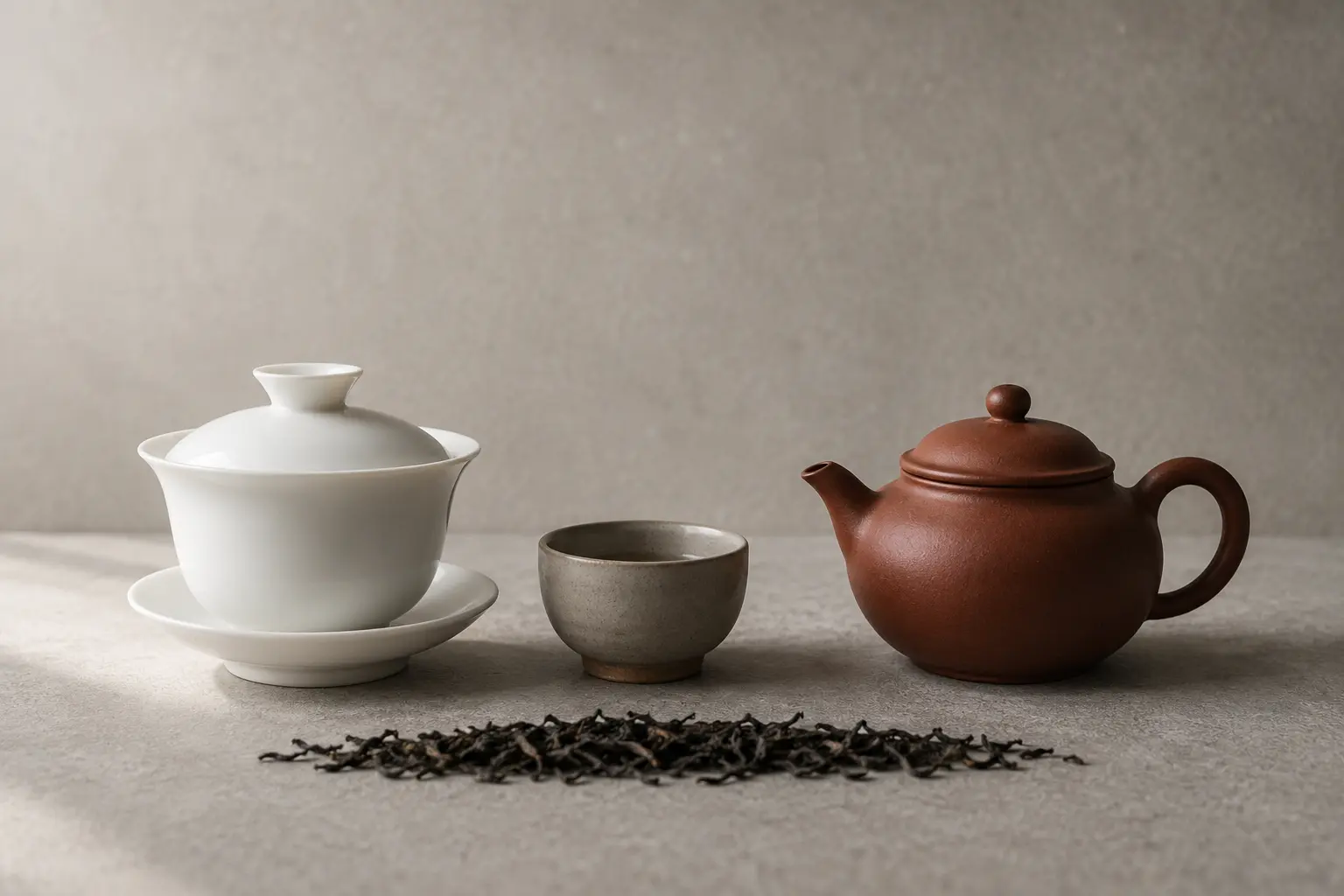
If you’ve decided to try gongfu tea, the first real decision is what to brew in: a gaiwan — a lidded porcelain bowl — or a Yixing teapot, the famous unglazed clay pot from eastern China. Both make excellent tea. They are not, however, equally good places to start.
The short answer
Start with a gaiwan. It costs less, brews any tea you put in it, is far easier to clean, and — because porcelain adds nothing of its own — it lets you taste a tea for what it actually is. A Yixing teapot is a wonderful second vessel, but it commits you to one type of tea and rewards experience you don’t have yet. Buy the gaiwan now; earn the teapot later.
The rest of this guide explains why, so the choice makes sense rather than just taking our word for it.
Meet the gaiwan
A gaiwan (盖碗, “lidded bowl”) is three pieces: a bowl, a lid, and usually a saucer. You add leaf, pour in water, and use the lid to hold the leaves back as you decant. It’s almost always porcelain or glazed ceramic, which is the whole point — the glaze seals the surface, so the vessel is neutral. It takes on nothing from the tea and gives nothing back.
That neutrality is why teachers and tea sellers reach for a gaiwan when they want to judge a tea honestly. Nothing stands between you and the leaf.
- Versatile — green, white, oolong, black, pu-erh: one gaiwan handles them all.
- Cheap — a perfectly good porcelain gaiwan costs less than a nice mug.
- Easy to clean — rinse and dry; the glaze holds no residue.
- Honest — you taste the tea, not the vessel.
The trade-off: porcelain is thin and the rim gets hot, so a freshly poured gaiwan can nip your fingers until you learn the grip (hold the rim and lid, not the bowl’s belly). And it loses heat quickly — usually a plus for delicate teas, occasionally a limit for ones that want sustained high heat.
Meet the Yixing teapot
A Yixing teapot is made from zisha (“purple sand”), a mineral-rich clay from Yixing in Jiangsu province. Crucially, it’s fired unglazed, leaving the clay slightly porous. That single fact drives everything people love — and everything that makes it the wrong first pot.
Because the clay breathes, it slowly absorbs the aromatic oils of the tea you brew. Over months this seasons the pot: it rounds off harsh edges, holds heat steadily through a long session, and — devotees say — builds a richer cup for the tea it has come to know. The flip side is just as real:
- One pot, one tea. Brew a smoky roasted oolong today and a fresh green tomorrow and you’ll taste yesterday’s tea in both. Most drinkers dedicate a pot to a single tea family.
- Fussy to keep. Never use soap — it soaks into the clay. You rinse with hot water and let the pot air-dry fully between sessions.
- A minefield to buy. Genuine zisha is limited, and much of the cheap “Yixing” online is dyed or coated pottery. More on that below.
None of this makes Yixing worse — it makes it specialized. A seasoned pot matched to the right tea is a genuine upgrade. It’s just an upgrade that assumes you already know your tea.
Gaiwan vs Yixing at a glance
| Gaiwan | Yixing teapot | |
|---|---|---|
| Material | Glazed porcelain (neutral) | Unglazed zisha clay (porous) |
| Works with | Every tea type | One tea, or one family |
| Effect on the tea | None — tastes it straight | Softens edges, builds over time |
| Heat retention | Drops quickly | Holds heat well |
| Cleaning | Rinse and dry | Rinse only, never soap |
| Typical cost | Low | Moderate to high (fakes abound) |
| Best for | Learning, tasting, any tea | A tea you already know you love |
What the material does to your cup
The real difference isn’t shape — it’s the surface. Glaze seals; raw clay breathes. A gaiwan reports the tea exactly, which is what you want while you’re still calibrating leaf, water, and time (see the ratios in our gongfu brewing guide). A Yixing pot quietly edits the tea: muting bitterness, lengthening the finish, smoothing a young or aggressive brew. That editing is a feature when you’ve chosen the pot to flatter a specific tea, and a liability when you haven’t.
Heat behaves differently too. The gaiwan’s quick cooling protects fragile greens and light whites. The Yixing’s thick walls hold temperature, which suits teas that want sustained heat — roasted oolong, ripe pu-erh, aged tea.
Which teas suit which vessel
If you do reach the point of dedicating a clay pot, match it to a tea that rewards what the clay does:
- Roasted oolong (Wuyi rock oolong, aged Tieguanyin) — high heat and a rounding pot bring out the depth.
- Ripe and aged pu-erh — the clay tames earthiness and holds the heat these dense teas want.
- Aged dark teas — similar logic: steady heat, softened edges.
And the teas that belong in a gaiwan, not clay:
- Green and yellow tea — too delicate; the neutral, fast-cooling gaiwan keeps them fresh and unmuddied.
- Light, fragrant oolong and white tea — you want every bit of aroma intact, not absorbed into a pot.
- Anything you’re tasting for the first time — judge it honestly before you decide it deserves a dedicated pot.
The fake-Yixing problem
This deserves its own warning, because it’s where beginners lose money. Real zisha clay comes from a limited area and a genuinely handmade pot takes skill and time — so it is rarely cheap. A great deal of what sells as “Yixing” online is ordinary pottery dyed to look the part, sometimes sealed with a coating that defeats the porosity you paid for in the first place.
You don’t need to become a clay expert to avoid the trap:
- Be suspicious of suspiciously low prices on “real Yixing.”
- Buy from sellers who say where the clay comes from and who made the pot.
- Treat a first clay pot as an inexpensive learning piece, not an heirloom.
A coated fake won’t season and won’t improve your tea — it’s just a heavy teapot. This risk is the strongest practical reason to delay the purchase until you know enough to buy well.
So, which should you buy first?
For almost everyone the order is the same:
- Buy a 100–150 ml porcelain gaiwan now. Learn to brew with it. Taste widely and find the tea you keep coming back to.
- Add a Yixing pot later — once you have a tea worth dedicating one to, and enough experience to buy a real one without overpaying.
A gaiwan never becomes useless, either. Even seasoned drinkers with a shelf of clay pots reach for the gaiwan to taste something new. It’s the one vessel you’ll use forever, which is exactly why it’s the one to start with.
When you’ve got your gaiwan, the next step is technique — the leaf ratios, water temperatures, and steeping rhythm in our step-by-step gongfu guide, or browse more brewing technique and tea types.
Sources & further reading
- Gaiwan — the lidded brewing bowl and its use (Wikipedia)
- Yixing clay teapot — zisha clay, history, and seasoning (Wikipedia)
- Yixing ware — Encyclopædia Britannica
Researched and reviewed by the Cha Wisdom editorial team. We buy and use the teaware we recommend, and update our guides when the facts or our recommendations change.
Frequently asked questions
- Is a gaiwan or a Yixing teapot better for beginners?
- A gaiwan. It's cheaper, works with every kind of tea, is easy to clean, and — because porcelain adds nothing of its own — it lets you taste a tea honestly while you learn. A Yixing pot is a worthwhile second purchase once you know which tea you drink most.
- Why can you only brew one type of tea in a Yixing teapot?
- Yixing clay is unglazed and porous, so it slowly absorbs the aroma and oils of whatever you brew. Over time that seasons the pot to flatter one tea — but it also means a roasted oolong pot will muddy a delicate green. Most drinkers dedicate each pot to a single tea or family.
- Are cheap Yixing teapots real?
- Often not. Genuine Yixing zisha clay is limited and much of the market is colored or coated pottery sold as the real thing. A truly handmade pot is rarely cheap. If you want one, buy from a seller who sources transparently rather than chasing the lowest price.
Keep reading
- Chinese Tea Ceremony: History, Meaning & How It Works
Explore gongfu tea hospitality: what happens at the tea table, guest etiquette, and the history behind it, with distinctions from wedding and Japanese tea rites.
- How to Brew Gongfu Tea Step by Step
A step-by-step walkthrough of brewing gongfu tea — warming, rinsing, pouring, decanting and re-steeping — with timings and sensory cues for every move.
- Water Temperature Guide for Every Chinese Tea Type
The right water temperature for green, white, oolong, black and pu-erh tea — a complete chart, why it matters, and how to hit it without a thermometer.