Pu-erh Tea: The Complete Beginner's Guide
What is pu-erh tea? A plain-English guide to raw vs ripe pu-erh — how it's made and aged, what it tastes like, and how to brew your first cup.
On this page
Pu-erh is the best-known Chinese tea deliberately made to be aged. White teas and other dark teas reward keeping too, but none is so defined by it: while most teas are at their best within months of picking, a good pu-erh can keep changing for decades — growing smoother, deeper, and more valuable as it goes. That single fact shapes everything about it: how it’s made, why it’s pressed into cakes, why some discs sell for the price of a car, and why a beginner can feel a little lost in front of the pu-erh shelf. This guide clears the fog. By the end you’ll know what pu-erh actually is, the one distinction that matters most, what it tastes like, and how to brew your first cup well.
What is pu-erh tea?
Pu-erh (普洱) is a post-fermented tea from Yunnan, in southwest China. Like all true tea it comes from Camellia sinensis, but specifically from a broad-leaf variety native to Yunnan’s old tea forests. It takes its name from Pu’er, a town that was once the great trading hub for these teas along the Tea Horse Road, the caravan routes that carried Yunnan tea to Tibet and beyond. Officially, true pu-erh must come from designated areas of Yunnan and be made from sun-dried large-leaf material — it’s a protected product, much like Champagne.
In the six-type system of Chinese tea, pu-erh sits in the dark, post-fermented family — the only category defined by genuine microbial fermentation rather than by oxidation alone. That fermentation is the source of pu-erh’s deep, earthy character and its almost unique ability to age.
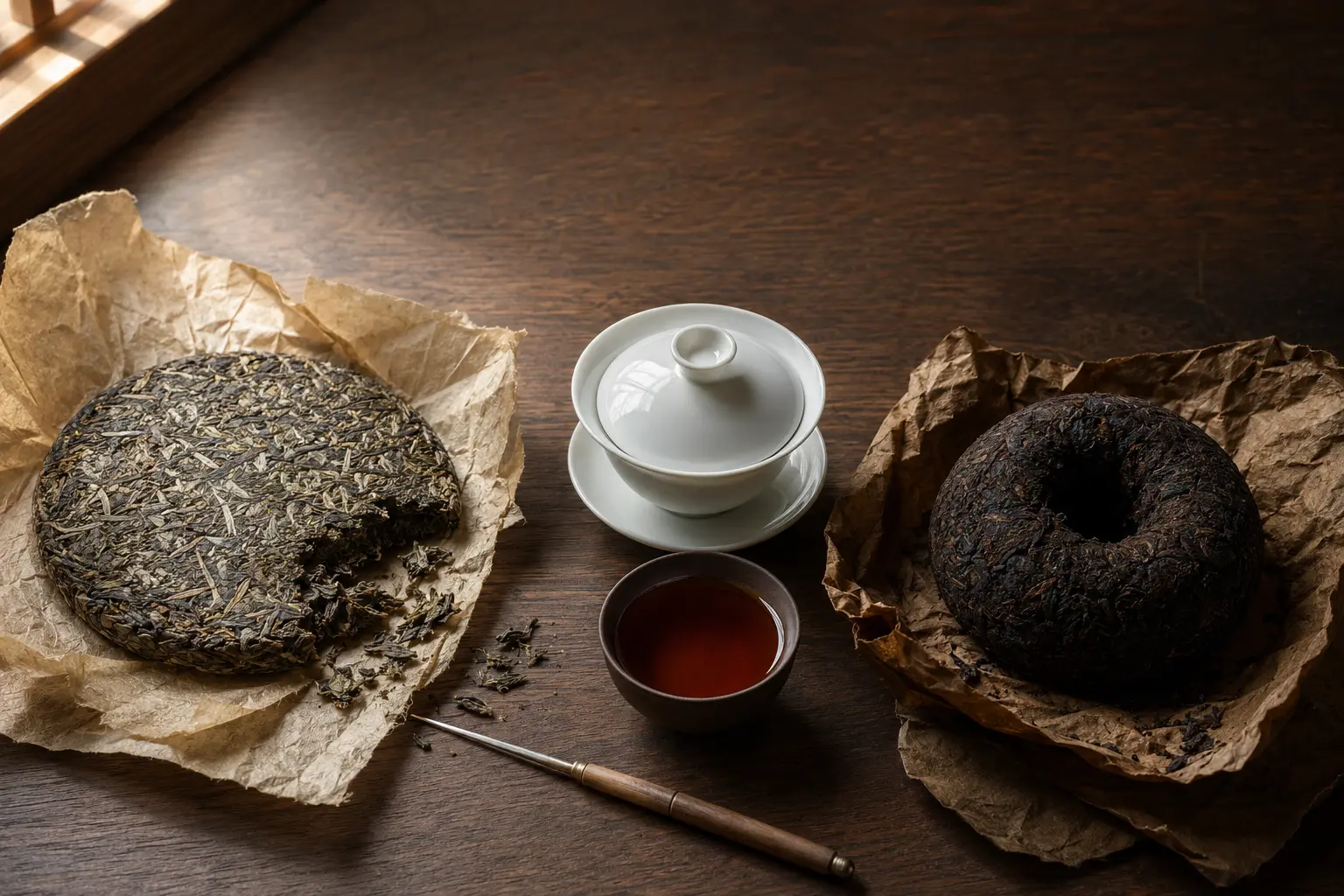
Two things make pu-erh unmistakable. First, it is usually compressed — into round cakes, bricks, or little bird’s-nest tuochas — rather than sold loose. Second, it is made with time in mind. A fresh green tea is a finished product; a pu-erh cake is closer to a young wine, something that will keep developing in the cupboard for years.
Raw vs ripe: the one distinction that matters most
If you remember only one thing about pu-erh, make it this: there are two kinds, and they are almost different drinks.
Raw pu-erh (生普, sheng) is the traditional kind. The leaves are picked, heated to halt oxidation, rolled, and sun-dried into a loose material called maocha, which is then steamed and pressed into cakes. There is no forced fermentation — instead, the pressed tea is left to transform slowly over years through gentle oxidation and microbial activity. Young raw pu-erh is bright, bitter, and astringent, with floral and vegetal notes not far from a green tea. Given a decade or three of good storage, it mellows into something woody, sweet, and profound.
Ripe pu-erh (熟普, shou) is the modern kind, developed in the early 1970s to mimic decades of aging in a matter of weeks. The maocha is piled damp and warm in a process called wet-piling (wò duī), where heat and microbes ferment it in roughly six to eight weeks. The result is dark, smooth, and earthy from the start — low in bitterness, ready to drink immediately, and far cheaper than aged raw pu-erh. This is why most newcomers start with ripe.
| Raw / Sheng (生普) | Ripe / Shou (熟普) | |
|---|---|---|
| How it’s made | Sun-dried, pressed; no forced fermentation | Maocha + wet-pile fermentation, then pressed |
| Age of the method | Centuries old | Developed in the early 1970s |
| Young flavor | Bitter, astringent, floral, vegetal | Smooth, earthy, woody, sweet |
| Does it age? | Yes — improves over years and decades | Mostly drink-ready; mellows a little more |
| Best for | Patience, collectors, exploring origin | Beginners, everyday cups, after meals |
Neither is “better.” Ripe is the friendly entry point; raw is the long game that serious drinkers fall down the rabbit hole chasing. For the close-up — how to tell them apart by color and aroma, how each ages, and which to drink first — see raw vs ripe pu-erh.
How pu-erh is made
Both kinds begin the same way. Workers pick the large leaves, often from old trees, and wither them. The leaves are then fixed with heat — a brief pan-firing that slows the oxidizing enzymes without killing them entirely — and rolled to bruise the cells. Crucially, the tea is then dried in the sun (shài qīng) rather than with high mechanical heat. That gentle sun-drying is what separates pu-erh’s raw material from ordinary green tea: it leaves the leaf alive with the enzymes and microbes that make aging possible. The loose, sun-dried result is maocha, the common starting point for everything that follows.
From here the roads split. For raw pu-erh, the maocha is lightly steamed to soften it and pressed into its final shape — a cake, brick, or tuocha — then wrapped and set aside to age. For ripe pu-erh, the maocha first goes through wet-piling: it’s heaped on a floor, dampened, covered, and turned over several weeks while microbes do in a single pile what years of storage would do naturally. Only then is it pressed. The skill of ripe pu-erh is in the piling — too little and it’s harsh, too much and it’s flat or sour.
Where pu-erh comes from: Yunnan’s tea mountains
Pu-erh is a tea of place. Yunnan’s old tea regions — Xishuangbanna, Lincang, and Pu’er prefecture — each leave a fingerprint, and for raw pu-erh especially, the mountain on the label can matter as much as the vintage. A handful of famous areas have become shorthand for particular characters: Lao Banzhang for sheer power and a bitterness that turns to deep sweetness; Yiwu for softness and elegance; Bingdao for delicate, honeyed clarity.
Tea from old, tall trees — gushu, or “ancient tree” — is prized over young plantation bushes for its depth, texture, and longevity, and it commands far higher prices. That premium is exactly why the most celebrated names are also the most counterfeited; a cake claiming to be Lao Banzhang at a bargain price almost certainly isn’t. You don’t need to memorize the map to enjoy pu-erh, but knowing that region drives both flavor and cost helps you read a shelf — and a price tag — with clearer eyes.
What pu-erh tastes like
Pu-erh’s reputation for tasting “like dirt” comes almost entirely from cheap, badly made ripe pu-erh. Good pu-erh is nothing of the sort.
Young raw pu-erh is vivid and a little wild: bitter and astringent up front, then floral, fruity, or vegetal, often finishing with a striking huigan — a sweetness that wells up in the throat after you swallow. Drinkers also talk about cha qi, the warming, almost physical “energy” a strong raw pu-erh can produce.
Aged raw pu-erh trades that brightness for depth: notes of dried fruit, camphor, old wood, honey, and damp forest, with the rough edges worn smooth. A well-stored twenty-year-old cake is one of the great experiences in tea.
Ripe pu-erh is the cozy one — smooth, round, and mellow, with flavors of loam, wood, dark chocolate, dates, and sometimes a clean “wet forest floor” quality. There is little to no bitterness, which is exactly why it suits both beginners and a quiet cup after a heavy meal.
The shapes: cakes, bricks, and tuochas
Most pu-erh is compressed, a habit that began for a practical reason: pressed tea was far easier to load onto horses and mules for the long journey out of Yunnan, and it happened to age more gracefully than loose leaf. The forms you’ll meet:
- Cake (饼茶, bǐngchá) — the classic round disc, traditionally 357 grams and sold in stacks of seven (the “seven sons cake”).
- Brick (砖茶, zhuānchá) — a rectangular slab, historically the most portable.
- Tuocha (沱茶) — a thick bowl or bird’s-nest shape, from a few grams up to hundreds.
- Loose (散茶, sǎnchá) — uncompressed, less common but the easiest to portion.
To get tea off a cake, don’t snap at it. Slide a pu-erh pick or a blunt knife into the side of the cake, parallel to its layers, and lever off a flake. Prying along the layers keeps the leaves whole, which makes for a cleaner, less bitter brew.
Reading a pu-erh cake
A wrapped cake can look like a wall of unfamiliar characters, but a few marks do most of the work. The wrapper typically names the producer, the year, the region or recipe, and whether the tea is raw or ripe. Tucked inside you’ll often find a small printed ticket (the neipiao) and a tiny label pressed into the cake itself (the neifei) — both traditionally used to signal authenticity.
You’ll also see recipe numbers, a convention from the big state-era factories. A classic like Menghai’s 7542, for instance, encodes a recipe first developed in ‘75, using a particular leaf grade, at that factory — it is not the year this particular cake was pressed, which trips up many beginners. Finished cakes are bundled in sevens into a tong, and tongs are stacked into a jian for shipping and storage. None of this is essential on day one, but it’s the vocabulary that turns a baffling shelf into a readable one — and helps you tell a transparent seller from a vague one.
How to brew pu-erh
Pu-erh is built for the gongfu method: a lot of leaf, a little water, and many short steeps. Here is a reliable starting point.
- Break off about 5–8 grams for a standard gaiwan, keeping the flakes as intact as you can.
- Rinse the leaves. Pour near-boiling water over them and tip it straight out after a few seconds. This wakes up the compressed leaf and rinses away dust — for ripe and aged pu-erh, a second rinse is normal.
- Use hot water, around 95–100°C. Pu-erh, unlike green tea, wants full heat.
- Steep short and build. Start at around 10 seconds and add a few seconds each round. A good pu-erh gives ten or more infusions, each a little different.
A gaiwan is the most versatile vessel, though many drinkers keep a dedicated Yixing clay pot for pu-erh because the porous clay is thought to round out its earthiness. If gongfu brewing feels like too much, you can also brew pu-erh “grandpa style” — a pinch of leaf in a large mug, topped up with hot water through the day — which suits ripe pu-erh especially well.
Aging, and why pu-erh is collected
Pu-erh is the only tea with a serious secondary market. Because good raw pu-erh improves for decades, cakes are bought, stored, traded, and occasionally speculated on like fine wine. Vintage, region (famous mountains such as Yiwu or Lao Banzhang command a premium), and the producing factory all move the price, and genuinely old cakes can sell for thousands.
Storage is the variable that makes or breaks aging. Dry storage — stable, moderate humidity in clean, ventilated, odor-free conditions — is the modern standard and produces clean, slow transformation. Wet storage, a traditional Hong Kong technique using high humidity to speed things up, can deepen a tea fast but risks mustiness and mold if mishandled. For a beginner the lesson is simpler: pu-erh absorbs whatever is around it, so keep it away from the kitchen, strong smells, damp, and direct light. For the full home setup — ideal humidity, what to keep it in, and how to spot mold — see how to store pu-erh at home.
A word of caution: where there is money and age, there are fakes. Be skeptical of suspiciously cheap “antique” cakes and dramatic origin stories. Buy from specialists who are transparent about year and source, and when you can, buy a sample before committing to a whole cake.
Is pu-erh good for you?
Pu-erh carries a long folk reputation as a digestive — in much of China it’s the tea you drink after a rich, fatty meal. Modern research is genuinely interesting but still early: a handful of small studies suggest fermented pu-erh may modestly influence blood lipids and cholesterol, possibly through compounds created during fermentation. That is a long way from a proven weight-loss aid, and you should treat the bold claims on marketing pages with skepticism. We dig into the studies in pu-erh tea and weight loss.
Like all true tea, pu-erh contains caffeine — roughly in the range of other teas, and more or less depending on the leaf and how hard you brew. If you’re sensitive, a lighter steep is your lever, not the type.
Common beginner mistakes
A few easy traps to sidestep:
- Brewing it like green tea. Pu-erh wants near-boiling water; treat it gently and it tastes flat and lifeless.
- Skipping the rinse. A quick first rinse wakes the compressed leaf and clears any storage dust — pour it away, don’t drink it.
- Judging young raw pu-erh as “broken.” It’s supposed to be sharp and bitter; that’s a tea in its youth, not a flaw.
- Chasing age before flavor. A good fresh ripe cake beats a dubious “aged” bargain every single time.
- Storing it beside coffee or spices. Pu-erh drinks in nearby smells, so give it clean, stable, odor-free air.
How to start with pu-erh
You do not need an aged cake or a big budget to begin. The sensible path:
- Start with ripe (shou) pu-erh. It’s inexpensive, forgiving, smooth, and immediately enjoyable. A modest ripe cake, tuocha, or some loose ripe is the ideal first purchase.
- Then try a young raw (sheng) pu-erh to taste the other side of the family — brighter, more bitter, more alive — and see whether its world appeals to you.
- Only then chase aged tea, and buy samples before committing to a cake.
Wherever you buy, favor specialist vendors who name the year, region, and type clearly, and start small. You can get the brewing fundamentals down first, or see where pu-erh fits among the other Chinese teas.
The short version
Pu-erh is Yunnan’s post-fermented tea, pressed into cakes and made to age. It comes in two kinds: ripe, which is smooth and ready to drink, and raw, which starts sharp and rewards patience over years. Buy a ripe cake to start, break off a few grams, rinse it, and brew it hot and short, gongfu style. Pu-erh is the most patient tea there is — and the one most likely to turn a curious beginner into a lifelong collector.
Sources & further reading
- Pu’er tea — raw vs ripe, aging and production (Wikipedia)
- Tea Horse Road — the trade routes pu-erh travelled (Wikipedia)
- Tea processing — fermentation and post-fermentation (Wikipedia)
- Chinese tea — Wikipedia
Researched and reviewed by the Cha Wisdom editorial team. Health notes reflect preliminary research and are not medical advice; we update our guides when the facts or our recommendations change.
Frequently asked questions
- What is pu-erh tea?
- Pu-erh is a post-fermented tea from Yunnan, China, made from a large-leaf variety of the tea plant and usually pressed into cakes or nests. Unlike most teas, it is made to be aged: with time and storage it keeps changing, growing smoother and more complex. It comes in two kinds — raw (sheng) and ripe (shou).
- What is the difference between raw and ripe pu-erh?
- Raw (sheng) pu-erh is sun-dried and pressed without forced fermentation; young, it is bitter and floral, and it slowly transforms over years of aging. Ripe (shou) pu-erh, invented in the early 1970s, is fermented quickly in a damp pile so it tastes smooth, earthy and mellow right away. Beginners usually find ripe pu-erh easier to enjoy first.
- Does pu-erh tea help with weight loss?
- Pu-erh is traditionally drunk after rich meals to aid digestion, and a few small studies suggest it may modestly affect blood lipids. But the evidence for real weight loss is limited and preliminary. Enjoy pu-erh for its flavor; treat strong weight-loss claims with skepticism.
- Does pu-erh tea expire?
- Not in the way green tea goes stale. Stored properly — stable, ventilated, odor-free and not too damp — pu-erh keeps for years or decades and often improves. The main risks are mold from too much moisture or off-flavors from absorbing nearby smells.
- How do you brew pu-erh tea?
- Break off a few grams, give the leaves a quick rinse with near-boiling water and discard it, then brew gongfu style: a high leaf-to-water ratio, water around 95–100°C, and many short infusions. Good pu-erh will give ten or more cups, each a little different.
Keep reading
- How to Store Pu-erh Tea at Home for Aging
How to store pu-erh tea at home for aging: the right humidity, temperature and air, what to keep it in, mistakes to avoid, and how to spot mold.
- White Tea Guide: The Least Processed Chinese Tea
White tea explained: how the least processed Chinese tea is made, its grades from Silver Needle to Shou Mei, how it ages, and how to brew it well.
- Raw vs Ripe Pu-erh: What's the Difference?
Raw (sheng) vs ripe (shou) pu-erh, explained: how to tell them apart by color, aroma and taste, how each ages, and which one to drink first.