The 6 Types of Chinese Tea, Explained
Green, white, yellow, oolong, black and dark — the six types of Chinese tea, explained by how each is made, with flavors, examples and brewing tips.
On this page
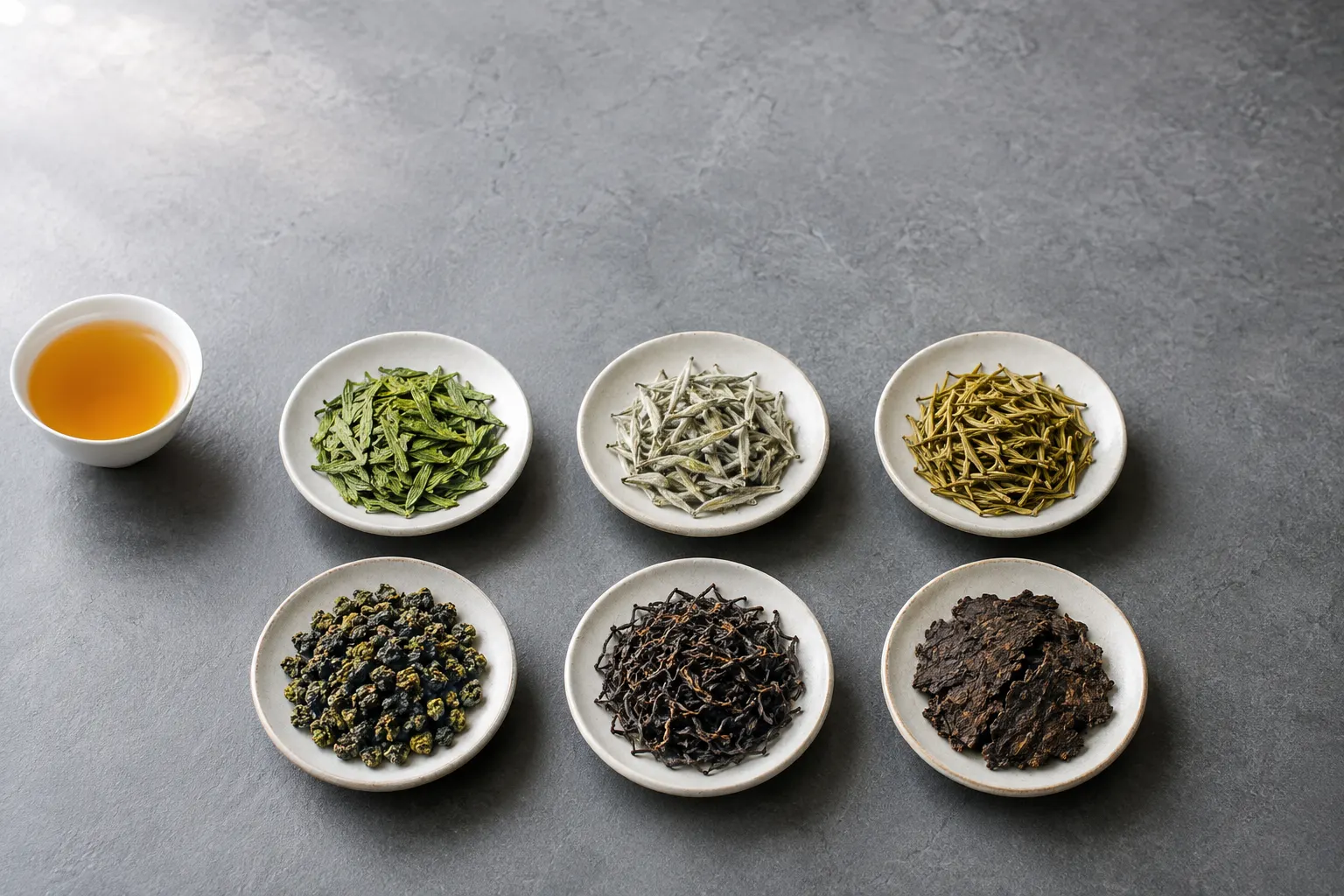
There are six types of Chinese tea, and the surprising part is that they all come from a single plant. Green, white, yellow, oolong, black, and dark tea are not different bushes or different regions — they are the same leaf taken down six different roads. What separates them is craft: how the fresh leaf is heated, bruised, oxidized, fermented, and dried. Learn to read those steps and you can place almost any Chinese tea you meet, predict roughly how it will taste, and brew it well. This guide walks through all six, in plain language.
How Chinese tea is actually classified
Every true tea — green, oolong, black, and the rest — comes from Camellia sinensis, an evergreen shrub native to East and South Asia. Herbal “teas” like chamomile or mint are infusions of other plants and sit outside this system entirely.
So if it is all one plant, what makes the categories? Processing. China’s tea tradition — and its modern national classification standard — sorts tea into six classes based on how the leaf is treated after picking. The single most important variable is oxidation: the same browning reaction that turns a cut apple from white to brown. Enzymes in the bruised leaf react with oxygen, and as they do, the tea’s color deepens and its flavor shifts from fresh and vegetal toward malty, fruity, and sweet.
Each type is essentially a decision about how far to let that reaction run, and when to stop it. Stop it immediately and you get green tea. Let it run to completion and you get black tea. Stop it partway — the trickiest, most artful choice — and you get oolong. Dark tea is the odd one out: it is defined not by oxidation but by a later step of true microbial fermentation, which is why it tastes so different from everything else.
One more thing worth clearing up early, because it confuses almost everyone: the color names refer to the leaf and the brewed liquor, not to a rulebook English speakers would recognize. What the West calls black tea, China calls red tea (hong cha) for its coppery color — and the Chinese term black tea (hei cha) means something else entirely: the post-fermented dark teas. Keep that in mind and the whole map gets easier to read.
The six types at a glance
| Type | Chinese name | Oxidation | Signature step | Typical flavor | Famous example | Water |
|---|---|---|---|---|---|---|
| Green | 绿茶 (lǜchá) | None (~0%) | Kill-green (pan-fire / steam) | Fresh, vegetal, nutty | Dragon Well (Longjing) | 75–80°C |
| White | 白茶 (báichá) | Very light | Wither and dry only | Soft, sweet, hay and honey | Silver Needle | 80–85°C |
| Yellow | 黄茶 (huángchá) | Light | Sealing-yellow (mèn huáng) | Mellow, smooth, sweet | Junshan Yinzhen | 80–85°C |
| Oolong | 乌龙 / 青茶 | Partial (10–80%) | Bruise, fix, often roast | Floral to roasted, mineral | Tieguanyin; Da Hong Pao | 90–95°C |
| Black (red) | 红茶 (hóngchá) | Full (~100%) | Full oxidation | Malty, sweet, cocoa | Keemun; Dianhong | 90–95°C |
| Dark | 黑茶 (hēichá) | Post-fermented | Damp-pile (wò duī) | Earthy, woody, smooth | Ripe pu-erh | 95–100°C |
The rows are ordered the way it helps to think about them: from the least processed leaf to the most transformed. Let’s take them one at a time.
Green tea — the unoxidized original
Green tea is the leaf caught as close to fresh as possible. Soon after picking, the leaves are heated — pan-fired in a wok (the Chinese tradition) or steamed (more common in Japan) — in a step called kill-green (shā qīng). The heat deactivates the oxidizing enzymes, locking in the green color and the fresh character before any browning can take hold. The leaves are then rolled and dried.
The result tastes bright and vegetal, often with a nutty, chestnut sweetness in pan-fired styles or a savory, marine note in steamed ones. China is the world’s great green-tea producer, and its classics are benchmarks: Dragon Well (Longjing) from Hangzhou, with its flat, glossy leaves and chestnut finish; Biluochun, tightly curled and floral; and Huangshan Maofeng from the misty mountains of Anhui. Brew green tea gently — around 75–80°C — because boiling water scorches its delicate compounds and turns the cup harsh and bitter.
White tea — barely touched
White tea is the least handled of all. There is no kill-green and no rolling; the leaves are simply withered and dried, often over a day or more. Because nothing stops the enzymes, a small amount of natural oxidation happens during that long wither, so white tea is lightly oxidized rather than truly raw.
The flavor is soft, quiet, and subtly sweet — think hay, melon, and honey, with a downy texture. The most prized example is Silver Needle (Baihao Yinzhen), made only from plump unopened buds covered in silvery down. White Peony (Bai Mudan) adds young leaves to the buds for more body, and Shou Mei is bolder still. Good white tea, especially pressed cakes, ages beautifully, deepening toward dried fruit and warm spice over years. Brew it at 80–85°C, a touch hotter for the leafier grades. For the grades, aging, and how to brew it, see our full white tea guide.
Yellow tea — the rare cousin of green
Yellow tea is the scarcest of the six, and the one most drinkers never meet. It begins like green tea, with a kill-green step, but adds a slow, gentle stage called sealing-yellow (mèn huáng): the warm, slightly damp leaves are wrapped or piled so they mellow under their own heat. That light, non-enzymatic oxidation rounds off the grassy edge of green tea, leaving a smoother, sweeter cup and a faint yellow cast to the leaf and liquor.
Classic yellow teas include Junshan Yinzhen from an island in Hunan’s Dongting Lake and Meng Ding Huangya from Sichuan. Because the sealing-yellow step is labor-intensive and the market small, true yellow tea is increasingly hard to find — many “yellow” teas sold today are really greens. Brew it like a green, at 80–85°C.
Oolong — the art of stopping halfway
Oolong (wūlóng, also called qīngchá) is the broadest and most technically demanding category, covering everything from roughly 10% to 80% oxidation. The leaves are withered, then repeatedly bruised or tossed to break the edges and start oxidation just at the rim of each leaf. When the maker judges the moment right, the oxidation is fixed with heat, and the tea is rolled and frequently roasted. Where you stop, and how you roast, defines the tea — which is why oolong rewards skill more than almost any other type.
The range is enormous. At the green end sit fragrant, floral, lightly oxidized oolongs like Anxi Tieguanyin and high-mountain Taiwanese styles. At the dark end are the roasted, mineral Wuyi rock oolongs (yancha) such as Da Hong Pao, and the intensely aromatic Phoenix Dancong, famous for mimicking the scent of flowers and fruit — our oolong guide maps the whole family. Oolong is the classic style for gongfu brewing, giving a dozen or more re-steeps from one set of leaves. Use hot water, around 90–95°C, and up to near-boiling for heavily roasted leaves.
Black tea — fully oxidized, fully developed
Black tea — hong cha, “red tea,” in Chinese — is the leaf taken all the way. After withering, the leaves are rolled hard to rupture their cells, then left to oxidize completely before drying. Full oxidation turns the leaf dark and the liquor a deep amber-red, and converts the fresh, green notes into malt, sweetness, and sometimes cocoa or dried fruit. Well-made Chinese black tea is smooth and gently sweet, with far less of the brisk astringency many associate with teabag blends.
China gave the world black tea, and its originals are still among the finest: Keemun (Qimen) from Anhui, with its wine-like, faintly smoky depth; Dianhong from Yunnan, rich and honeyed and studded with golden buds; and Lapsang Souchong (Zhengshan Xiaozhong) from the Wuyi mountains — widely considered the first black tea ever made, and in its smoked version, unmistakable. Brew at 90–95°C. It takes well to both quick gongfu steeps and the longer Western pour.
Dark tea — the fermented one
Dark tea (hēichá) stands apart because it is the only category defined by true microbial fermentation, not just oxidation. After a kill-green and rolling, the leaves go through a controlled, damp piling stage (wò duī) in which microbes and time slowly transform them. The tea is then often pressed into cakes or bricks and can age for years or decades, growing smoother and more complex as it does.
The flavor is earthy, woody, and mellow, sometimes sweet and almost soil-like in the best sense, with none of the grassy bite of fresh tea. The famous example is ripe (shou) pu-erh from Yunnan, alongside Hunan’s Anhua dark tea and Guangxi’s Liu Bao. Pu-erh has its own complete guide; in short, raw (sheng) pu-erh begins life much like a green tea and ferments slowly over years of storage, while ripe (shou) pu-erh is deliberately fermented in months to taste aged from the start. Pu-erh is sometimes treated as its own class, but it lives within this post-fermented family. Brew dark tea near boiling, 95–100°C, and give it a quick rinse first to wake the compressed leaves.
What about jasmine, chrysanthemum, and flower teas?
A common point of confusion: where do jasmine tea, chrysanthemum tea, and the floral blends on shop shelves fit? Mostly, they don’t — at least not as a seventh type.
Scented teas like jasmine are a real tea, usually a green or white base, that has been layered with fresh flowers so the leaf absorbs their aroma, then separated from them. The leaf is still green or white tea; the jasmine is perfume, not a category. The same goes for osmanthus oolong or rose black tea — the flower flavors a tea that already belongs to one of the six.
Herbal “teas” are different. Chrysanthemum, chamomile, and pure flower or fruit infusions contain no Camellia sinensis at all, so botanically they are not tea — they are tisanes. They have their own pleasures, and chrysanthemum in particular has a long place in Chinese tradition, but they sit outside the six-type system.
The oxidation spectrum: one mental model
If you remember nothing else, remember the dial. Picture oxidation as a slider from raw to fully developed:
- Green stops it immediately — fresh and vegetal.
- White and yellow allow only the lightest touch — soft and sweet.
- Oolong stops it somewhere in the middle — and where is the whole art.
- Black lets it run to completion — malty and deep.
- Dark steps off the dial entirely into microbial fermentation — earthy and aged.
Hold that picture, recall that the color names describe the leaf and liquor (and that Chinese “red tea” is Western “black”), and you can slot any unfamiliar tea into place the moment you learn how it was made.
A quick word on caffeine
One myth is worth retiring: that green tea is always low in caffeine and black tea always high. It is not that simple. Caffeine in your cup depends far more on the leaf material — buds and young leaves carry more than mature ones — on the cultivar and growing conditions, and above all on how you brew: more leaf, hotter water, and longer steeps all pull out more caffeine. A strong steep of a bud-heavy green can easily out-caffeinate a light, quick black. If caffeine matters to you, control the brew rather than trusting the type.
How to store each type
How long a tea keeps — and whether it improves with age — follows directly from how it was made, which is one more reason the six types are worth knowing.
- Green and yellow tea are best drunk fresh, ideally within a year. Their bright, vegetal character fades quickly. Keep them cool, sealed, dark, and away from strong smells; for long storage, the freezer works if the bag is airtight.
- Oolong and black tea are more forgiving and hold their character for one to several years. Heavily roasted oolongs can even round out with a little rest.
- White and dark tea are the agers. Stored properly — stable, ventilated, odor-free, and not too dry — pressed white cakes and pu-erh deepen and sweeten over years or decades, and prized aged examples command real prices.
The enemies are the same for every type: heat, light, moisture, oxygen, and strong odors. Airtight, opaque, and cool is the rule.
Which type should you start with?
There is no single right door in. If you like things fresh and light, begin with a green such as Dragon Well, or a green-style Tieguanyin oolong. If you prefer something bold and malty, a Yunnan Dianhong black is hard to beat. And if what draws you is the ritual — small pot, many infusions, watching a tea unfold cup by cup — start with an oolong and the gongfu method.
The real advice is to taste across the spectrum. Buy small amounts of two or three very different teas, brew them side by side, and pay attention to what you reach for again. You can explore each type in more depth or dig into brewing technique once you’ve found a tea you love. Six types, one plant — and once you can read a tea by how it was made, the whole of Chinese tea opens up.
Sources & further reading
- Chinese tea — the six-type system and its classics (Wikipedia)
- Tea processing — how oxidation and firing define each type (Wikipedia)
- Camellia sinensis — the single plant behind all true tea (Wikipedia)
- Tea — Encyclopædia Britannica
Researched and reviewed by the Cha Wisdom editorial team. We update our guides when the facts or our recommendations change.
Frequently asked questions
- How many types of Chinese tea are there?
- There are six. Chinese tea is classified by how the leaf is processed, not by the plant or the region: green, white, yellow, oolong, black (called red tea in Chinese), and dark (post-fermented). All six come from the same species, Camellia sinensis.
- Is pu-erh a green tea or a black tea?
- Neither, in the Chinese system. Pu-erh belongs to the dark, post-fermented family. Ripe (shou) pu-erh is deliberately fermented to taste smooth and earthy, while raw (sheng) pu-erh starts out closer to a green tea and transforms slowly over years of aging.
- Why is Chinese black tea called red tea?
- In Chinese, fully oxidized tea is hong cha, literally red tea, named for its reddish liquor. The English word black refers to the dark dry leaf. Confusingly, the Chinese term for black tea (hei cha) is a different, post-fermented category — what English speakers call dark tea.
- Which type of Chinese tea has the least caffeine?
- It depends far more on the leaf and how you brew than on the type. Bud-heavy teas, hotter water and longer steeps all raise caffeine; a gentle, brief steep of any tea lowers it. The old rule that green has the least and black the most is unreliable.
- Which Chinese tea is best for beginners?
- Many people start with a forgiving green like Dragon Well or an approachable Yunnan black such as Dianhong. If you want the full multi-infusion gongfu experience, a Tieguanyin oolong is a great entry point. The best approach is to taste across the spectrum and notice what you enjoy.
Keep reading
- How to Store Pu-erh Tea at Home for Aging
How to store pu-erh tea at home for aging: the right humidity, temperature and air, what to keep it in, mistakes to avoid, and how to spot mold.
- White Tea Guide: The Least Processed Chinese Tea
White tea explained: how the least processed Chinese tea is made, its grades from Silver Needle to Shou Mei, how it ages, and how to brew it well.
- Raw vs Ripe Pu-erh: What's the Difference?
Raw (sheng) vs ripe (shou) pu-erh, explained: how to tell them apart by color, aroma and taste, how each ages, and which one to drink first.