Oolong Tea Guide: Types, Flavors & How to Brew
Oolong tea explained: how oxidation and roast run from floral Tieguanyin to roasted Wuyi rock tea — with the main types, flavors and brewing tips.
On this page
Oolong is the in-between tea, and that is exactly what makes it so rewarding. Where green tea is stopped almost raw and black tea is taken all the way, oolong is halted somewhere in the middle — and “somewhere in the middle” turns out to cover an enormous range. Add roasting on top, and a single category stretches from fresh, floral, and creamy to dark, toasty, and mineral. No other type of tea offers as much to explore, which is why oolong is where so many drinkers fall deepest down the rabbit hole. This guide maps the territory: what oolong is, how it’s made, the main families, and how to brew it well.
What is oolong tea?
Oolong (乌龙茶, also called qīngchá) is a partially oxidized Chinese tea. Like every true tea it comes from Camellia sinensis, but its defining trait is that oxidation — the same browning that separates green tea from black — is allowed to run only partway, anywhere from roughly 10% to 80%, and then stopped. That single decision places oolong squarely between green and black in the six-type system of Chinese tea.
Most oolong comes from four homelands: the Wuyi mountains and Anxi in Fujian, the Phoenix mountains of Guangdong, and the high mountains of Taiwan, whose tea-making grew from Fujianese roots. Each has its own classic styles, but they all share two flavor levers the maker pulls: how far to oxidize, and how much to roast. Learn to think in those two dials and the whole category falls into place.
A short history of oolong
Oolong is, surprisingly, one of the younger types of tea — there was no oolong in the Tang or Song dynasties of classic tea lore. Most accounts place its birth in Fujian’s Wuyi mountains during the Ming-to-Qing transition, several centuries ago, when makers found that letting the leaf wither and bruise before firing produced something richer and more aromatic than green tea. From Wuyi the craft spread south to Anxi, where Tieguanyin emerged, east to Guangdong’s Phoenix mountains, and across the strait to Taiwan, whose settlers carried Fujianese cuttings and techniques. The name itself — wūlóng, “black dragon” — has several competing legends, from the dark, twisting shape of the leaves to a tea farmer the tea was supposedly named after. Whatever its origin, no category has stayed more inventive since.
How oolong is made
Oolong is the most labor-intensive tea to produce, and the steps explain its complexity. After picking, the leaves are withered, first in the sun and then indoors. Then comes the step that defines oolong: the leaves are repeatedly shaken and tossed (yáo qīng), bruising their edges so that oxidation begins at the rim of each leaf while the center stays green. The maker lets this edge-oxidation build to a chosen point — tasting, smelling, judging — and then fixes the leaf with heat to stop it exactly there. Finally the tea is rolled or twisted into shape, dried, and frequently roasted.
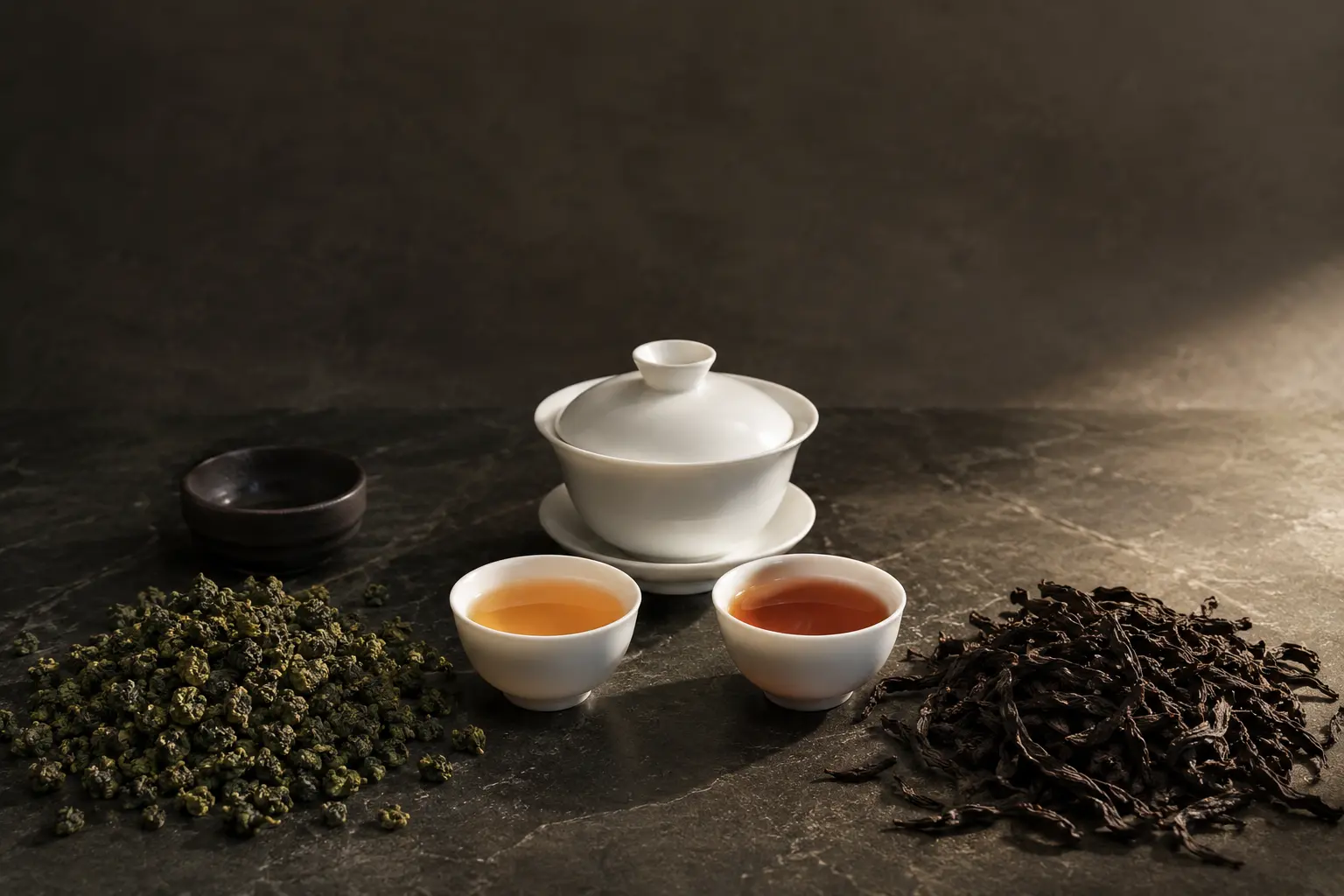
That shaping gives oolong its two visual families. Some are rolled into tight balls or pellets that unfurl dramatically in the pot — the style of Anxi Tieguanyin and most Taiwanese oolong. Others are left as long, twisted strips — the style of Wuyi rock tea and Phoenix Dancong. Shape is not just looks: rolled leaf is denser, so you use less of it by volume, and it tends to release over more infusions.
A final step deserves its own mention: roasting. Many oolongs are baked after drying, traditionally over charcoal, in repeated low, slow firings spread over days — and sometimes revisited across years. Roasting is a craft of its own: too hot or too fast and the tea turns ashy and flat; done well, it adds warmth, sweetness, and length without ever tasting burnt, and it lets a tea keep and even improve with age. It is the second great lever, after oxidation, that an oolong maker pulls.
The two dials: oxidation and roast
Almost any oolong can be placed by two questions.
How oxidized is it? Lightly oxidized oolongs (10–30%) stay close to green tea: fresh, floral, vegetal, with bright high notes of orchid and lilac. Heavily oxidized ones (up to ~80%) move toward black tea: ripe fruit, honey, and deeper, rounder body.
How roasted is it? Roasting, traditionally over charcoal, runs from none at all to a deep, repeated bake. A light roast keeps the tea green and fragrant; a heavy roast adds toasted nuts, caramel, dark sugar, and a warmth that can age and mellow for years. Modern tastes have pushed many oolongs greener and less roasted than they once were, but the traditional roasted styles remain some of the most profound teas there are.
Rolled or twisted: why shape matters
Before the families, one practical distinction. Oolong comes in two shapes, and they behave differently in the pot. Rolled oolongs — Tieguanyin, Taiwanese high-mountain — are compressed into tight pellets that look like very little in the gaiwan but expand enormously as they open, so you use less by volume and they release slowly over many infusions. Twisted oolongs — Wuyi rock tea, Dancong — keep their long leaf shape, take up more room dry, and tend to give up their flavor a little faster and more intensely. The lesson when you brew: judge a rolled oolong by how much it will become, not by how much it looks. A thin layer of pellets is plenty.
The main families of oolong
| Family | Origin | Shape | Oxidation / roast | Signature flavor | Examples |
|---|---|---|---|---|---|
| Tieguanyin | Anxi, Fujian | Rolled | Light ox., light roast | Orchid, creamy, floral | Anxi Tieguanyin |
| Wuyi rock (yancha) | Wuyi, Fujian | Twisted | Med–high ox., charcoal roast | Mineral, roasted, “rock rhyme” | Da Hong Pao, Rou Gui, Shui Xian |
| Phoenix Dancong | Guangdong | Twisted | High ox., light–med roast | Fruity, floral, honeyed | Mi Lan Xiang (honey orchid) |
| High-mountain | Taiwan | Rolled | Light ox., little roast | Floral, buttery, creamy | Alishan, Lishan |
| Dong Ding | Taiwan | Rolled | Medium ox., medium roast | Toasty, sweet, smooth | Dong Ding |
| Oriental Beauty | Taiwan | Twisted | High ox., no roast | Honey, ripe fruit, muscatel | Bai Hao |
Anxi Tieguanyin
Named “Iron Goddess of Mercy,” Tieguanyin from Anxi in southern Fujian is the most famous rolled oolong. In its modern jade style it is lightly oxidized and lightly roasted, giving a strikingly floral, almost creamy cup with notes of orchid and lilac and a lingering sweetness drinkers call guanyin yun. Traditional Tieguanyin is more oxidized and roasted, trading some of that freshness for toasted, honeyed depth. Tightly rolled, it unfurls over many infusions.
Wuyi rock oolong (yancha)
From the dramatic cliffs of the Wuyi mountains in northern Fujian come the twisted, charcoal-roasted rock oolongs (yánchá). Grown among mineral-rich rock, they are prized for yán yùn, a “rock rhyme” of deep minerality beneath the roast. The classics are Da Hong Pao (the legendary “big red robe”), Rou Gui (spicy, with a cinnamon edge), and Shui Xian (woody and orchid-like). These are autumn-and-firelight teas: warm, complex, and long. For the full picture — rock rhyme, cliff grades, the famous varieties and the roast — see our Wuyi rock oolong guide.
Phoenix Dancong
From Guangdong’s Phoenix Mountain, Dancong (“single bush”) oolongs are famous for one astonishing trick — mimicking the aroma of flowers and fruit. They are sorted into fragrance types with names like Mi Lan Xiang (honey orchid), almond, and ginger flower. Highly oxidized and twisted, a good Dancong is intense, aromatic, and a little untamed, often with a pleasant edge of bitterness that turns sweet.
Taiwanese oolong
Taiwan, with deep roots in Fujianese tea-making, produces some of the world’s most celebrated oolongs. High-mountain (gāoshān) teas like Alishan and Lishan are rolled, lightly oxidized, and barely roasted — floral, buttery, and sweet, with a clean alpine character. Dong Ding is the classic roasted Taiwanese oolong, toasty and smooth. And Oriental Beauty (Bai Hao) is the outlier: heavily oxidized, never roasted, and famously made from leaves bitten by a tiny leafhopper, which triggers a honeyed, muscatel sweetness.
How to brew oolong
Oolong is the quintessential tea for the gongfu method: a lot of leaf, a little water, and many short steeps that let you taste the tea change cup by cup.
- Use plenty of leaf. For rolled oolongs, fill the bottom of a gaiwan; they look like little; they will expand to fill it. For twisted oolongs, loosely fill it about halfway.
- Rinse first, especially for rolled and roasted teas: a quick pour of hot water, tipped straight out, to wake the leaf.
- Match the water to the style. Greener oolongs are happy around 90–95°C; roasted and Wuyi teas want near-boiling, 95–100°C.
- Steep short and build. Start around 15–20 seconds and add a few seconds each round. A good oolong gives six to ten or more infusions; watch a rolled tea slowly open across them.
A gaiwan is the most versatile vessel; many drinkers reserve a small Yixing pot for roasted oolongs. New to the method? Start with our gongfu brewing guide and the brewing fundamentals.
What to look for when buying oolong
A few habits steer you toward good oolong. Buy from sellers who name the specifics — the cultivar, region, harvest season, and roast level — rather than a vague “oolong tea.” For rolled styles, look for tight, heavy, glossy pellets; for twisted styles, for whole, unbroken strips rather than dust and fragments. Decide on a roast level and buy to it: greener for floral and fresh, darker for toasty and warm. And buy samples before cakes of it. Oolong spans such a range that a single bag tells you little; two or three small, contrasting samples teach you more in an afternoon than a year of guessing. One more thing: freshly roasted oolong sometimes needs a few weeks to settle, so don’t judge a roasted tea the day it arrives.
Oolong and caffeine
Like all true tea, oolong contains caffeine. It’s tempting to file it neatly between green and black, but how much ends up in your cup depends far more on the leaf and how you brew than on oxidation level: a high-leaf gongfu session delivers more caffeine per cup than a light Western steep, whatever the style. Oolong also carries L-theanine, an amino acid often associated with a calmer kind of alertness, though the research on its everyday effects is still limited. As for broader health claims, oolong shares the polyphenols studied across all teas; the research is generally positive but rarely specific to oolong, so enjoy it for the flavor first. If that caffeine keeps you up at night, see our guide to Chinese tea for sleep.
Which oolong should you try first?
There is no wrong door, but there are friendly ones:
- If you like fresh and floral, start with a jade Tieguanyin or a Taiwanese high-mountain oolong — bright, forgiving, and easy to love.
- If you like toasty and warm, try a roasted Dong Ding or a Wuyi Rou Gui.
- If you like bold and aromatic, reach for a Phoenix Dancong.
Buy small amounts of two contrasting styles — say a green Tieguanyin and a roasted Wuyi — and brew them side by side; the difference is the fastest way to find your taste. Once you’ve found a favorite, explore the other Chinese teas.
A note on aging
Most green oolongs are best drunk fresh, while their florals are vivid. But roasted oolongs — traditional Tieguanyin, Dong Ding, and Wuyi rock teas — can be aged and periodically re-roasted, deepening over years into something darker and sweeter, with notes of dried fruit and wood. Aged oolong is a quieter, less famous cousin of aged pu-erh, and well worth seeking out.
The short version
Oolong is the partially oxidized tea, and its magic is range. Picture two dials — oxidation and roast — and you can place any oolong you meet: floral and green at one end, dark and toasty at the other, with Tieguanyin, Wuyi rock tea, Dancong, and the Taiwanese oolongs spread across the middle. Brew it gongfu style, with generous leaf and many short steeps, and let it unfold. Of all the Chinese teas, oolong gives the most back to a patient cup.
Sources & further reading
- Oolong — partial oxidation, families and origins (Wikipedia)
- Tea processing — withering, bruising, fixing and roasting (Wikipedia)
- Theanine — background on L-theanine in tea (Wikipedia)
- Chinese tea — Wikipedia
Researched and reviewed by the Cha Wisdom editorial team. We update our guides when the facts or our recommendations change.
Frequently asked questions
- What is oolong tea?
- Oolong is a partially oxidized Chinese tea that sits between green and black. By stopping oxidation somewhere in the middle — anywhere from about 10% to 80% — and often adding a roast, makers create the widest range of flavors of any tea type, from fresh and floral to dark and toasty.
- Is oolong a green tea or a black tea?
- Neither. Oolong is its own category, defined by partial oxidation. Lightly oxidized oolongs lean green, floral and fresh; heavily oxidized ones lean toward black tea, with fruit and honey. Where the maker stops, and how much they roast, is the whole art.
- What does oolong tea taste like?
- It depends entirely on the style. Green oolongs like jade Tieguanyin or Taiwanese high-mountain tea taste of orchid, lilac and cream. Roasted oolongs like Wuyi rock tea taste of toasted nuts, caramel and minerals. Phoenix Dancong can mimic honey, almond or ripe fruit.
- How many times can you steep oolong tea?
- A good oolong, brewed gongfu style with plenty of leaf, will give six to ten or more infusions, and rolled oolongs in particular keep unfurling and changing for many cups. Add a few seconds to the steep each round as the leaves open up.
- Which oolong is best for beginners?
- A lightly oxidized, lightly roasted oolong is the easiest place to start — a jade Tieguanyin or a Taiwanese high-mountain tea, both floral and forgiving. If you prefer darker, toastier flavors, a roasted Dong Ding is a friendly introduction to that side of the family.
Keep reading
- How to Store Pu-erh Tea at Home for Aging
How to store pu-erh tea at home for aging: the right humidity, temperature and air, what to keep it in, mistakes to avoid, and how to spot mold.
- White Tea Guide: The Least Processed Chinese Tea
White tea explained: how the least processed Chinese tea is made, its grades from Silver Needle to Shou Mei, how it ages, and how to brew it well.
- Raw vs Ripe Pu-erh: What's the Difference?
Raw (sheng) vs ripe (shou) pu-erh, explained: how to tell them apart by color, aroma and taste, how each ages, and which one to drink first.