Chinese Tea for Sleep: 6 Best Options Ranked
The best Chinese teas for sleep are caffeine-free. We rank 6 traditional options — from sour jujube seed to chrysanthemum — and explain what actually helps.
On this page
Search for “Chinese tea for sleep” and you’ll find plenty of pages recommending green tea or pu-erh before bed. That advice has a problem: those are caffeinated teas, and caffeine is a stimulant. The honest answer is that the best teas for sleep aren’t true teas at all — they’re the caffeine-free herbal infusions of the Chinese tradition. Here’s what actually helps, ranked, with a clear-eyed look at the evidence.
First, the caffeine problem
Every true tea — green, white, oolong, black, and pu-erh — comes from the same plant, Camellia sinensis, and they all contain caffeine. Aging, fermentation, and light steeping change how much, but none of them removes it. A cup in the evening can sit in your system for hours: caffeine has a half-life of roughly five to six hours, so a late-afternoon mug is still working at bedtime.
Tea does contain L-theanine, an amino acid associated with a calm, focused state, and there’s preliminary research that it may ease anxiety and support sleep quality. But L-theanine comes packaged with caffeine in real tea, and at night the stimulant generally wins. If you want a warm cup before bed, the smart move is to set the true teas aside and reach for something caffeine-free.
So this ranking is of caffeine-free options rooted in Chinese tradition — ordered by how strongly each is tied to rest, and how much support the idea has beyond folklore.
1. Sour jujube seed (suan zao ren)
If Chinese tradition has a dedicated sleep remedy, this is it. Suan zao ren (酸枣仁), the seed of the sour jujube, has been the go-to herb for restlessness and insomnia in Chinese medicine for centuries, and it’s the one modern researchers take most seriously: several small studies and a long clinical history point to a genuine calming, sleep-supporting effect, though the quality of evidence is still limited.
Brewed alone the seeds make a mild, slightly sour, nutty infusion; they’re often simmered rather than steeped, and frequently combined with other calming herbs. Of everything on this list, suan zao ren is the option most specifically about sleep.
2. Chrysanthemum (ju hua)
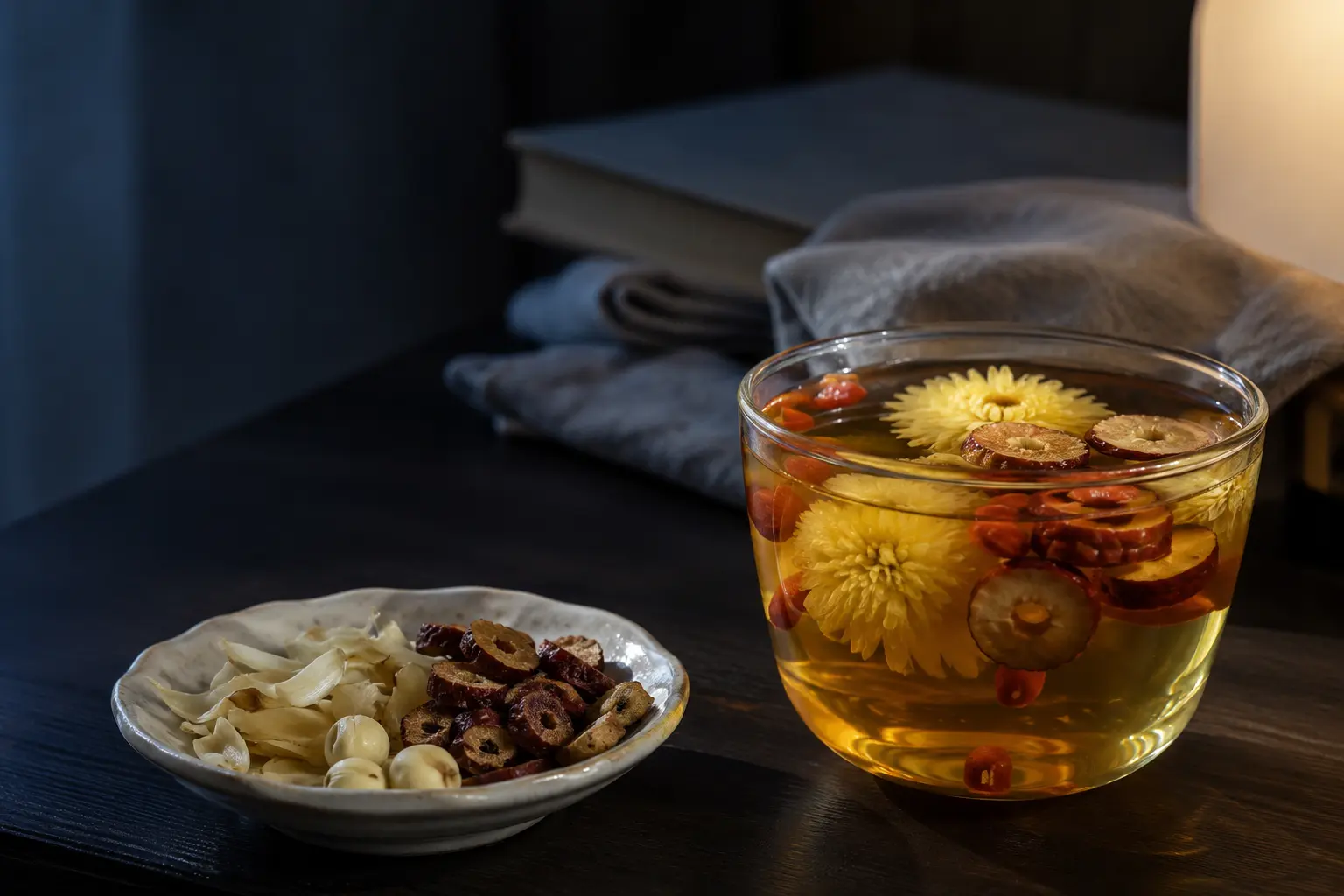
The everyday favorite. Chrysanthemum tea (菊花茶) is a caffeine-free infusion of dried chrysanthemum flowers, valued in Chinese tradition as cooling and calming — the gentle cup you reach for to wind down, soothe tired eyes, or settle after a long day. It’s light, floral, and faintly sweet, and pairs naturally with a little goji or rock sugar.
The calming reputation is traditional rather than clinically proven, but chrysanthemum’s great virtues are that it’s pleasant, widely available, and caffeine-free — an easy nightly cup. One caution: it’s part of the daisy family, so skip it if you’re allergic to ragweed or related plants, and consult a doctor before drinking it regularly in pregnancy.
3. Lily bulb (bai he)
Lily bulb (百合, bai he) — the dried bulb of an edible lily — is used in Chinese tradition to “calm the spirit,” a category of remedies aimed at restlessness and an overactive mind at night. It’s most often simmered into a soft, faintly sweet soup or congee with other ingredients, but it also makes a gentle infusion.
The evidence here is traditional, not clinical, so treat it as a soothing ritual rather than a proven sedative. As a warm, caffeine-free wind-down with a long culinary history, it earns its place.
4. Lotus seed heart (lian zi xin)
The small green germ inside a lotus seed, lian zi xin (莲子心), is one of the more pointed traditional choices for sleep. In Chinese medicine it’s said to “clear heart fire” — the agitated, can’t-switch-off state that keeps you awake — and it’s used specifically for restlessness and insomnia.
Be warned: it is genuinely bitter, so it’s usually used in small amounts and often blended. A pinch in hot water, perhaps with a little chrysanthemum to soften it, is the usual approach. Caffeine-free, and the most “medicinal-tasting” option on this list.
5. Jujube (red date / da zao)
The whole red date, da zao (大枣), is the nourishing, comforting end of the spectrum. Where the sour jujube seed targets sleep directly, the sweet red fruit is used more broadly in Chinese tradition to calm the spirit and ease mild anxiety, and it makes a warm, naturally sweet, caffeine-free infusion that’s genuinely nice to drink.
Sliced dates steeped in hot water — often with goji, longan, or a little ginger — are a classic cozy nighttime cup. The sleep link is gentle and traditional, but it’s an easy, pleasant habit with no caffeine to work against you.
6. Goji berry (gou qi zi)
Goji berries (枸杞, gou qi zi) rarely star on their own for sleep, but they’re the near-universal companion to the teas above — a handful dropped into chrysanthemum, red date, or lily-bulb infusions for sweetness and a traditional “nourishing” role. Caffeine-free and mild, they round out a bedtime blend.
One important caution: goji can interact with blood thinners such as warfarin, and with some blood-pressure and diabetes medications. If you take any of those, check with your doctor before making goji a nightly habit.
What about real tea in the evening?
If you love actual tea and want a cup after dinner, you don’t have to give it up entirely — just respect the caffeine. A few sensible habits:
- Drink it earlier. Finish your caffeinated tea several hours before bed.
- Steep it light. A short, gentle steep pulls out less caffeine than a long, hard one — see our water temperature guide for control over extraction.
- Know your sensitivity. Some people clear caffeine quickly and are fine with an early-evening cup; others aren’t. Pay attention to your own response.
What aging doesn’t do is remove caffeine — an aged white tea or a mellow ripe pu-erh still has it, even if it feels gentler. For the hour before bed, caffeine- free is the only reliable rule.
How to brew a bedtime cup
These infusions are forgiving. A simple approach:
- Use hot water, around 90–100°C — flowers, seeds, and dried fruit aren’t delicate the way green tea is.
- Steep longer than you would tea: 5–10 minutes, or a gentle simmer for seeds and bulbs like suan zao ren and lily.
- Blend to taste. Chrysanthemum, red date, and goji are natural partners; a little lotus seed heart or rock sugar tunes the balance.
- Drink it 30–60 minutes before bed, as part of winding down.
A note on evidence and safety
Most of these remedies rest on long traditional use rather than strong clinical proof. Sour jujube seed has the most modern research behind it, but even there the studies are small. Treat them as gentle, pleasant aids and rituals — not as cures.
And take real insomnia seriously. Persistent trouble sleeping can have causes a bedtime tea won’t fix, and some of these herbs carry cautions — in pregnancy, with allergies, or alongside medications. This article is general information, not medical advice; talk to a doctor about ongoing sleep problems or before adding herbs to your routine, especially if you’re pregnant, nursing, or taking medication.
The short version
The best Chinese “tea” for sleep is a caffeine-free one. Skip green tea and pu-erh before bed — they’re caffeinated — and reach instead for sour jujube seed or chrysanthemum, the two traditional choices most tied to rest, with lily bulb, lotus seed heart, red date, and goji rounding out a calming blend. Brew it warm, steep it long, and drink it as you wind down.
Explore more in our health section, or read up on the types of Chinese tea and their caffeine.
Sources & further reading
- Suanzaoren (Ziziphi Spinosae Semen) for sleep quality improvements: a systematic review and meta-analysis — clinical evidence for the herb most tied to sleep (PMC)
- Chinese herbal medicine for insomnia: a systematic review of randomized controlled trials — a measured review that also flags the limited quality of the trials (PubMed)
- Chrysanthemum tea — the caffeine-free flower infusion (Wikipedia)
- Ziziphus jujuba — jujube and its seed in traditional use (Wikipedia)
- Theanine — L-theanine and relaxation (Wikipedia)
- Caffeine — half-life and effects on sleep (Wikipedia)
Researched and reviewed by the Cha Wisdom editorial team. This is general information, not medical advice; health notes reflect preliminary or traditional evidence. We update our guides when the facts or our recommendations change.
Frequently asked questions
- What is the best Chinese tea for sleep?
- A caffeine-free one. The traditional Chinese choices most associated with sleep are sour jujube seed (suan zao ren) and chrysanthemum, both naturally caffeine-free. Avoid true teas — green, oolong, black, pu-erh — close to bedtime, because they all contain caffeine.
- Does green tea help you sleep?
- Not before bed. Green tea contains caffeine, which is a stimulant, so it works against sleep in the hours before you turn in. Green tea does contain L-theanine, an amino acid linked to calm, but the caffeine usually wins out at night. Drink green tea earlier in the day instead.
- Is chamomile a Chinese tea?
- Not really — chamomile is the classic Western bedtime herb. The Chinese tradition reaches for different caffeine-free plants for rest: chrysanthemum, sour jujube seed, lily bulb, lotus seed heart and jujube. They fill a similar role with a different flavor and history.
- Is it safe to drink herbal tea for sleep every night?
- For most healthy adults, gentle herbal infusions are fine in moderation, but they aren't risk-free. Some — like chrysanthemum and goji — have cautions in pregnancy or with certain medications, and persistent insomnia deserves a doctor's attention rather than self-treatment. This article is general information, not medical advice.
Keep reading
- Chinese Tea for Anxiety and Stress Relief
Chinese tea and everyday stress: compare caffeine-free herbs with green and jasmine tea, understand the L-theanine evidence, and know the safety limits.
- Chrysanthemum Tea: Caffeine, Benefits & Side Effects
Is chrysanthemum tea caffeine-free? Learn when blends contain caffeine, plus the benefits, brewing tips, side effects, and allergy cautions to know.
- Pu-erh Tea and Weight Loss: What the Research Says
Can pu-erh tea help with weight loss? Compare the extract research with ordinary brewed tea, understand the evidence limits, and avoid slimming-tea claims.