Chrysanthemum Tea: Caffeine, Benefits & Side Effects
Pure chrysanthemum tea is naturally caffeine-free. Blends with pu-erh, green, black, or oolong tea contain caffeine from the tea leaves, so check the ingredients rather than the drink's name.
Compare caffeine in chrysanthemum blends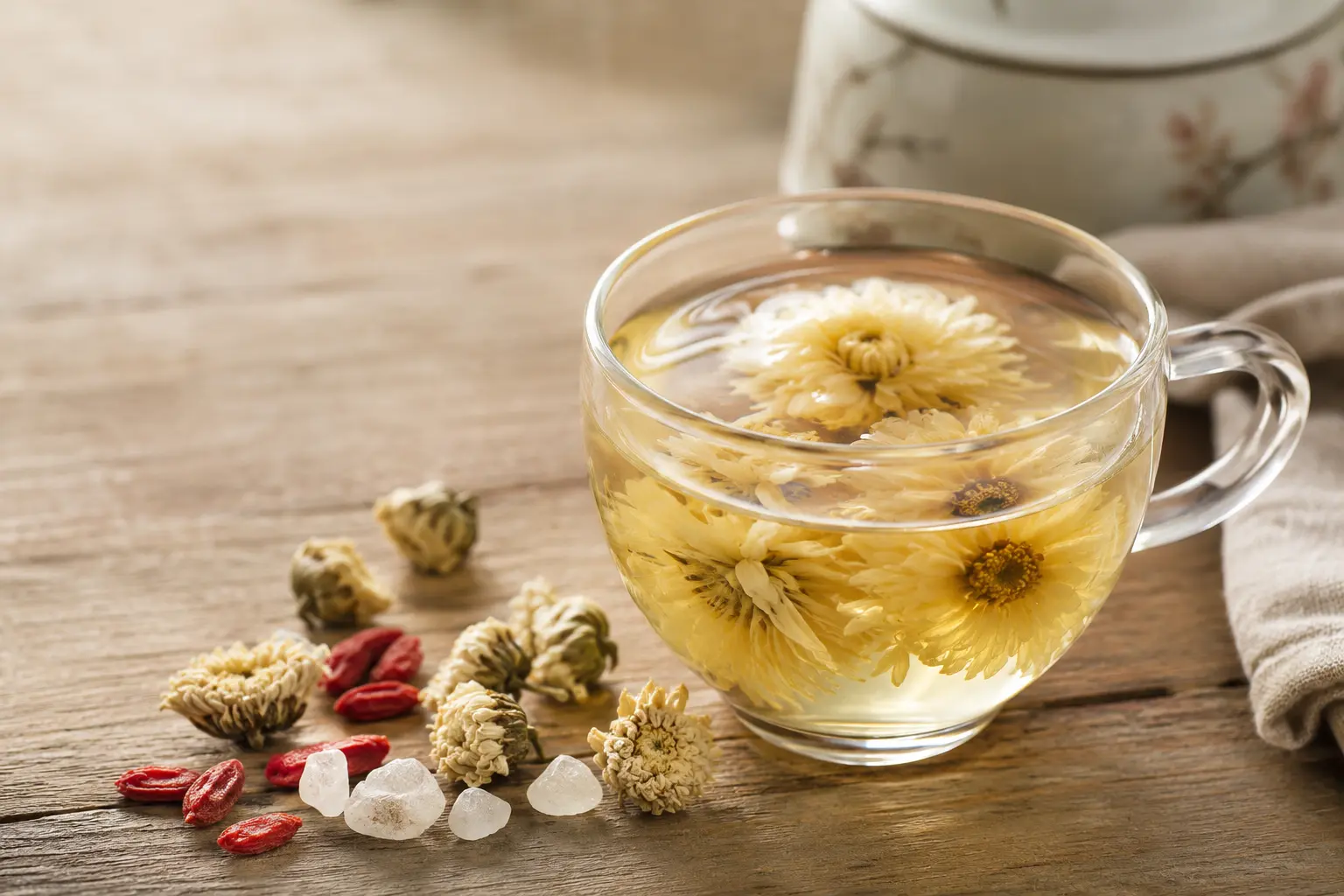
On this page
Chrysanthemum tea (菊花茶, ju hua cha) made from flowers alone contains no caffeine. If the flowers are blended with pu-erh or other tea leaves, the drink contains caffeine from those leaves. This guide explains how to tell them apart, then covers the flower types, brewing, traditional uses, research, and safety.
What is chrysanthemum tea?
Chrysanthemum tea is a herbal infusion of dried chrysanthemum flowers — usually Chrysanthemum morifolium, sometimes the more medicinal Chrysanthemum indicum. Despite the name, it isn’t a “tea” in the strict sense: it doesn’t come from the tea plant, Camellia sinensis, the way green, oolong, and pu-erh do. The whole dried blossoms are steeped in hot water, opening back up into flowers in the cup and giving a clear, light-gold liquor that tastes soft, floral, and lightly honeyed.
It’s enjoyed plain, sweetened with rock sugar, or — most classically — blended. Two pairings are everywhere in China: chrysanthemum with goji berries (a combination traditionally linked to the eyes), and chrysanthemum with ripe pu-erh, a mellow blend called ju pu that softens the tea’s earthiness with floral sweetness.
Does chrysanthemum tea have caffeine?
Pure chrysanthemum tea is naturally caffeine-free because it is made only from chrysanthemum flowers, not Camellia sinensis leaves. The exception is a blend that includes true tea: green, black, oolong, or pu-erh leaves all add caffeine. That means ju pu contains caffeine from its pu-erh even though the chrysanthemum flowers themselves do not.
| Drink | Contains caffeine? | What to check |
|---|---|---|
| Pure chrysanthemum flowers and water | No | Flowers are the only ingredient |
| Chrysanthemum and goji berries | No, if these are the only ingredients | Some prepared blends also add tea leaves |
| Chrysanthemum and pu-erh (ju pu) | Yes | Pu-erh is a caffeinated tea |
| Chrysanthemum with green, black, or oolong tea | Yes | Any of these tea leaves adds caffeine |
For bottled, instant, or restaurant drinks, read the ingredient list or ask which tea is used as the base. There is no single caffeine amount for all blends: it depends on the tea leaves, quantity, and brewing. Caffeine-free also does not mean risk-free; see the allergy and medication cautions.
The main types
Not all chrysanthemum is the same. A few names are worth recognizing:
| Type | Chinese | Character |
|---|---|---|
| Hangbaiju | 杭白菊 | The everyday white chrysanthemum from Hangzhou; soft, sweet, mellow |
| Gongju (“tribute”) | 贡菊 | A refined white flower from Huangshan; clean and fragrant |
| Taiju (buds) | 胎菊 | Unopened flower buds, the prized early pick; sweeter and more concentrated |
| Chuju | 滁菊 | A fluffy white variety from Anhui, valued in tradition |
| Wild (yejuhua) | 野菊花 | Small, yellow, distinctly bitter; more medicinal than for casual drinking |
For a pleasant daily cup, Hangbaiju and Taiju buds are the friendliest. The small yellow wild chrysanthemum is much more bitter and is treated more as a herb than a drink.
Benefits: tradition and evidence
Here’s where a clear head helps, because chrysanthemum tea is surrounded by big claims.
In Chinese tradition, chrysanthemum is a classic cooling herb said to “clear heat” — the cup for a hot day, red or tired eyes, headaches, or the flushed, agitated feeling of too much stress or rich food. It’s also considered calming, which is why it appears in our guides to Chinese tea for sleep and tea for anxiety and stress. These uses rest on centuries of practice rather than modern trials.
What research shows is promising but early. Chrysanthemum flowers are rich in antioxidant flavonoids such as luteolin and apigenin, and laboratory studies report antioxidant and anti-inflammatory activity. The honest caveat: most of that work is in test tubes and animals, not human trials, so it doesn’t prove that drinking the tea treats or prevents any condition. The sensible takeaway is to enjoy chrysanthemum tea as a pleasant, caffeine-free ritual with a long tradition behind it — not as medicine.
Chrysanthemum and tired eyes
If chrysanthemum has one signature use, it’s this. In Chinese tradition the flower is closely tied to the eyes — a soothing cup for eyes that are red, dry, or tired, which is exactly why the chrysanthemum-and-goji pairing is so beloved and why so many people reach for it after a long day at a screen. The flavonoid luteolin, abundant in chrysanthemum, is of genuine interest to researchers for its antioxidant role, but studies on eye health specifically are still preliminary and mostly not about drinking the tea. Treat it as a pleasant, warm ritual for screen-weary eyes — and rest your eyes properly too, which is the part that really helps.
How to brew chrysanthemum tea
It’s one of the easiest infusions to make, and forgiving:
- Use whole dried flowers — about 4–6 blossoms (or a teaspoon of buds) per cup. A clear glass is lovely here, since the flowers reopen as they steep.
- Pour water around 90°C over them. It needn’t be boiling; very hot water can make delicate flowers taste flat.
- Steep 3–5 minutes, until the liquor is pale gold. Don’t over-steep — long, hard steeps turn chrysanthemum bitter.
- Re-steep two or three times; the flowers keep giving.
- Blend to taste — a few goji berries, a little rock sugar or honey, or a base of ripe pu-erh for ju pu.
Add honey only once the cup has cooled a little, to keep its delicate aroma.
Classic ways to drink it
Plain chrysanthemum is lovely, but it shines in company. A few traditional combinations worth trying:
- Chrysanthemum and goji — the everyday wellness cup, a handful of red goji berries lending sweetness and color to the flowers.
- Ju pu (菊普) — chrysanthemum brewed with ripe pu-erh, the florals lifting the tea’s deep earthiness. It’s a staple in Cantonese dim sum houses for a reason.
- Eight-treasure tea (八宝茶) — chrysanthemum joins goji, red dates, longan, rock sugar, and more in a sweet, restorative northwestern blend served in a lidded cup.
- Iced in summer — brew it stronger, chill it, and drink it cold; as a “cooling” tea, chrysanthemum makes a wonderfully refreshing hot-weather drink.
How to choose and store it
A little care at the shop makes a better cup. Buy whole, intact flowers with their petals and form still recognizable, rather than crumbled bits and dust — the prized Taiju buds and good Hangbaiju (from Tongxiang) or Gongju (from Huangshan) are worth seeking out by name. Color should look natural, a soft off-white or pale yellow, and the smell should be cleanly floral.
One quality caution worth knowing: dried chrysanthemum is sometimes sulfur-fumigated to brighten its color and prevent mold. Over-fumigated flowers can look unnaturally vivid and carry a sharp, sour, slightly chemical smell; naturally dried flowers are the better buy. Store whatever you choose in an airtight container, away from light, heat, and moisture — the flowers fade and can grow musty if they take on damp. Like all dried flowers, chrysanthemum slowly loses its fragrance, so buy it in amounts you’ll drink within a year or so, and let your nose be the judge: fresh flowers smell brightly floral, while old or poorly kept ones turn flat, dusty, or faintly sour.
Side effects and who should be careful
Gentle doesn’t mean risk-free. A few cautions are worth taking seriously — this is the part the cheerful “10 benefits” articles tend to skip.
- Allergies are the main concern. Chrysanthemum belongs to the daisy (Asteraceae) family, alongside ragweed, marigolds, and daisies. If you’re allergic to any of those — or to ragweed pollen — you may react to chrysanthemum tea, from itching and rashes to more serious responses. Approach with real caution if you have such allergies.
- It can be mildly sedating. That’s welcome at bedtime, less so if you need to be sharp; notice how it affects you.
- Medication interactions. Memorial Sloan Kettering notes that chrysanthemum may interact with some drugs, including raising the levels of immunosuppressants — so transplant patients and others on such medicines should avoid it.
- Pregnancy and breastfeeding. There isn’t enough evidence to call it safe in these cases, so the cautious advice is to check with a doctor first.
- A traditional note. Because chrysanthemum is considered cooling in Chinese medicine, those who “feel the cold” easily or have a sensitive, easily upset stomach are traditionally advised to drink it in moderation.
This article is general information, not medical advice. If you’re pregnant, nursing, taking medication, or prone to plant allergies, talk to a doctor before making chrysanthemum tea a regular habit.
The short version
Chrysanthemum flowers make a caffeine-free infusion, and a daily favorite across China, especially the mellow Hangbaiju and sweet Taiju buds. Goji berries add no caffeine, but blending the flowers with ripe pu-erh does. The flowers are full of antioxidant flavonoids and the tradition behind them is rich, but the human evidence for specific health benefits is still thin, so enjoy it for pleasure first. Brew 4–6 flowers at around 90°C for a few minutes, don’t over-steep, and mind the cautions — especially the daisy-family allergy risk and medication interactions.
Explore more in our health section, or see how chrysanthemum fits a bedtime or stress-relieving cup.
Sources & further reading
- Phytochemicals, therapeutic benefits and applications of chrysanthemum flower: a review — flavonoids and the (largely preclinical) research (PMC)
- Chrysanthemum — uses, side effects and drug interactions (Memorial Sloan Kettering)
- Chrysanthemum tea — the flower infusion and its types (Wikipedia)
Researched and reviewed by the Cha Wisdom editorial team. This is general information, not medical advice; health notes reflect preliminary or traditional evidence. We update our guides when the facts or our recommendations change.
Frequently asked questions
- What is chrysanthemum tea good for?
- In Chinese tradition it's a cooling, calming infusion used to settle after a hot or stressful day, soothe tired eyes, and ease 'heat' symptoms. The flowers are rich in antioxidant flavonoids, and lab studies point to anti-inflammatory and antioxidant activity — but that's mostly preclinical, not proof of benefit in people. Enjoy it as a pleasant, caffeine-free ritual rather than a medicine.
- Does chrysanthemum tea have caffeine?
- Pure chrysanthemum tea is naturally caffeine-free because it is made from flowers, not leaves from the tea plant. However, blends containing green tea, black tea, oolong, or pu-erh do contain caffeine from those tea leaves. Check the ingredients if you're buying a blend rather than plain dried chrysanthemum flowers.
- How do you make chrysanthemum tea?
- Put 4–6 dried flowers in a cup or pot, pour water around 90°C over them, and steep 3–5 minutes until the liquor turns pale gold. The flowers re-steep two or three times. It's lovely with a few goji berries or a little rock sugar, and don't over-steep, as long steeps turn it bitter.
- What are the side effects of chrysanthemum tea?
- The main risk is allergy: chrysanthemum is in the daisy (Asteraceae) family, so people allergic to ragweed, daisies, or marigolds may react. It can also be mildly sedating, may interact with some medications — including immunosuppressants — and isn't well studied in pregnancy. If you're pregnant, nursing, on medication, or prone to plant allergies, check with a doctor first.
- Can you drink chrysanthemum tea every day?
- For most healthy adults a cup or two a day is generally fine, and it's a popular daily drink across China. But it isn't risk-free — mind the allergy and medication cautions, and in Chinese tradition it's considered 'cooling,' so those who feel the cold easily or have digestive upset are advised to go gently. This is general information, not medical advice.
Keep reading
- Pu-erh Tea: The Complete Beginner's Guide
What is pu-erh tea? A plain-English guide to raw vs ripe pu-erh — how it's made and aged, what it tastes like, and how to brew your first cup.
- Chinese Tea for Anxiety and Stress Relief
Chinese tea and everyday stress: compare caffeine-free herbs with green and jasmine tea, understand the L-theanine evidence, and know the safety limits.
- Water Temperature Guide for Every Chinese Tea Type
The right water temperature for green, white, oolong, black and pu-erh tea — a complete chart, why it matters, and how to hit it without a thermometer.