Raw vs Ripe Pu-erh: What's the Difference?
Raw (sheng) vs ripe (shou) pu-erh, explained: how to tell them apart by color, aroma and taste, how each ages, and which one to drink first.
On this page
If you’ve read our pu-erh guide, you know the single most important thing about the tea: it comes in two kinds, raw and ripe, and they taste almost nothing alike. This article is the close-up on that split — how the two are made, how to tell them apart in the cup, how each changes with age, and which one belongs in your first order.
The short answer
Raw (sheng) pu-erh is the original: sun-dried and pressed with no forced fermentation, so it starts out green, bitter, and bright, and transforms slowly over years or decades of storage. Ripe (shou) pu-erh is the modern shortcut: fermented fast in a warm, damp pile so it’s dark, smooth, and earthy from the day it’s made.
If you just want a cup to enjoy tonight, buy ripe. If you’re intrigued by tea that ages like wine and want to follow it for years, that’s raw. Most people meet pu-erh through ripe and wander into raw later.
Two names, a lot of confusion
Half the muddle around pu-erh is vocabulary, so let’s clear it first.
- Raw = sheng (生) = “green” pu-erh. Sometimes labeled “raw,” “green,” or just sheng. Confusingly, young raw pu-erh resembles green tea but is not the same thing — it’s sun-dried and made to age, where green tea is made to drink fresh.
- Ripe = shou (熟) = “cooked” pu-erh. Labeled “ripe,” “cooked,” or shou (also romanized shu). “Cooked” refers to the wet-pile fermentation, not to any actual cooking.
So “cooked,” “ripe,” and “shou” all mean the same dark, mellow tea; “raw,” “green,” and “sheng” all mean the brighter one that ages. Get those two clusters straight and most pu-erh labels suddenly make sense.
How to tell them apart
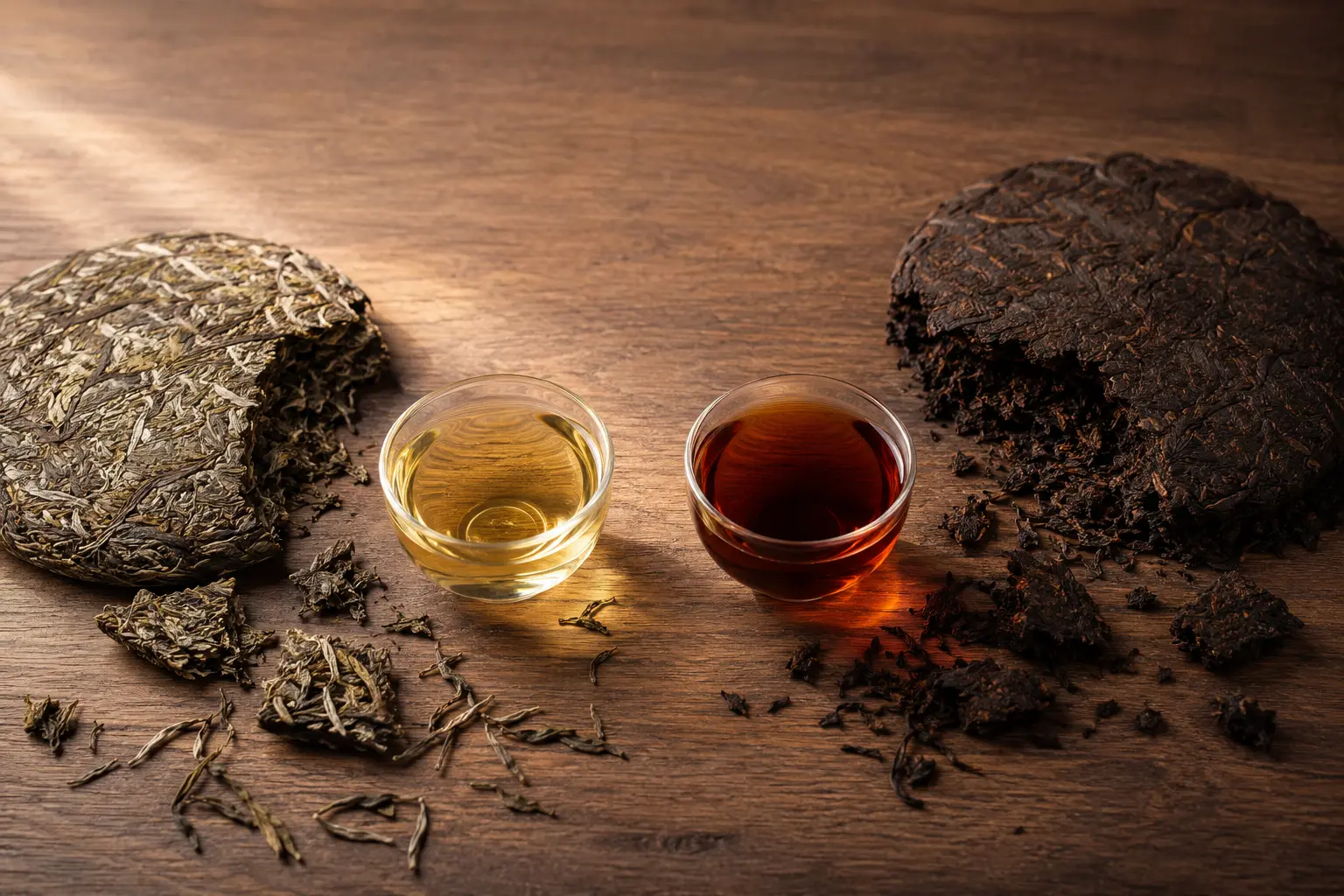
You rarely need a label. Once you’ve seen each, raw and ripe are easy to tell on sight and smell:
| Raw / sheng (young) | Ripe / shou | |
|---|---|---|
| Dry leaf | Green, olive, grey-green | Dark brown to near black |
| Liquor color | Pale gold to greenish-yellow | Deep red-brown, almost opaque |
| Aroma | Floral, fruity, vegetal, fresh | Earthy, woody, loam, dark cocoa |
| Taste | Bitter and brisk up front, sweet finish | Smooth, round, mellow, little bitterness |
| Body | Brisk, lively, astringent | Thick, soft, soothing |
The liquor is the giveaway. Pour a ripe pu-erh and it runs dark and opaque, close to coffee; pour a young raw and it’s clear and bright, more like a golden green tea. Aged raw is the one that can fool you — after a couple of decades its liquor deepens to orange and red, edging toward ripe’s territory, though the aroma stays cleaner and more complex.
The real difference: wet-piling
Everything above traces back to one step that ripe pu-erh has and raw doesn’t.
Both teas start identically, as sun-dried loose leaf called maocha (the full process is in our pu-erh guide). For raw pu-erh, that maocha is simply steamed and pressed into a cake, then left to transform on its own over years. There is no shortcut — time and storage do the work.
Ripe pu-erh adds wet-piling (渥堆, wò duī). The maocha is heaped into piles, dampened, covered, and turned for roughly six to eight weeks while heat and microbes ferment it. In under two months it accomplishes much of what years of aging would do to a raw cake: the bitterness burns off, the color darkens, and the tea turns smooth and earthy. Only then is it pressed.
This technique is recent. It was developed around 1973, at the Kunming and Menghai tea factories, precisely to give drinkers an aged-style pu-erh without the decades-long wait. That’s why every ripe pu-erh in the world is, in a sense, an imitation of old raw pu-erh — a very good one. The skill is all in the pile: too little fermentation and it stays harsh, too much and it goes flat or sour.
How each one ages
This is where raw and ripe truly part ways.
Raw pu-erh is built to age. Young, it’s sharp and floral; over five, ten, twenty years of good storage it slowly mellows, the bitterness receding and notes of dried fruit, honey, camphor, and old wood emerging. This decades-long arc is the whole reason pu-erh has a collector’s market — a well-stored old sheng cake is one of tea’s great experiences, and priced accordingly.
Ripe pu-erh is mostly already there. Wet-piling has done the heavy lifting, so a fresh ripe cake is ready to drink immediately. It does keep changing, but gently: the first year or two mainly clears a slight “wet-pile” funk that new shou can carry, leaving it cleaner and rounder. Aging a ripe cake is worthwhile but modest — you won’t see the dramatic transformation a raw cake undergoes.
In short: with raw, patience is the point; with ripe, patience is optional.
Strength, caffeine, and your stomach
A practical difference beginners notice fast. Both have caffeine in the usual tea range, but young raw pu-erh tends to feel stronger — more stimulating, with the warming buzz drinkers call cha qi — and it can be rough on an empty stomach, thanks to its briskness and bitterness. The old advice to never drink young sheng before breakfast has real basis.
Ripe pu-erh feels gentler: smooth, low in bitterness, and easy on the stomach, which is exactly why it’s the after-dinner cup of choice across much of China. If pu-erh has ever left you jittery or queasy, it was almost certainly a young raw — try a ripe, brew it a touch lighter, and don’t drink it on an empty stomach.
Price and value
Raw and ripe sit very differently on a price shelf:
- Young raw is usually affordable — it’s effectively a finished tea waiting to age, so you’re not paying for storage yet.
- Aged raw is where prices climb steeply: every year of careful storage adds cost and risk, and famous mountains and vintages reach eye-watering numbers.
- Ripe is generally inexpensive and consistent. Because fermentation, not decades, does the smoothing, you get an aged-style cup without the aged-cake price.
For value and reliability as a beginner, ripe is hard to beat. The expensive end of pu-erh is almost entirely an aged-raw story.
Brewing each one
Both love the gongfu method — lots of leaf, near-boiling water, many short steeps — but the dials differ slightly.
- Ripe (shou): rinse the leaves twice with hot water and discard, to wake the compressed leaf and clear any pile dust. Then brew hot (95–100°C) and short; ripe is forgiving and gives a dozen smooth, even cups. It also brews well “grandpa style,” a pinch left to steep in a big mug.
- Raw (sheng): one rinse is enough. Use hot water too, but manage the bitterness with short steeps — pour quickly on the early rounds, especially with young sheng, and lengthen as it opens. Long steeps pull out harshness, not strength.
Many drinkers keep a dedicated Yixing clay pot for ripe pu-erh, since the porous clay is thought to round out its earthiness — though a neutral gaiwan brews either one beautifully and lets you taste it honestly.
So which should you drink first?
For almost everyone, the order is the same:
- Start with ripe (shou). Smooth, cheap, forgiving, and immediately enjoyable — the friendliest possible introduction to pu-erh.
- Then try a young raw (sheng) to taste the bright, bitter, living other half of the family and see whether its world pulls you in.
- Only then chase aged raw, buying samples before whole cakes.
Neither kind is “better.” Ripe is the easy everyday cup; raw is the long, rewarding rabbit hole. Knowing which is in your cup — and why it tastes the way it does — is the first real step into pu-erh. From here you can go back to the full pu-erh guide, nail down the brewing fundamentals, or see where pu-erh sits among the six types of Chinese tea.
Sources & further reading
- Pu’er tea — raw vs ripe, wet-piling and aging (Wikipedia)
- Fermentation in tea processing — oxidation vs post-fermentation (Wikipedia)
- Tea — Encyclopædia Britannica
Researched and reviewed by the Cha Wisdom editorial team. We update our guides when the facts or our recommendations change.
Frequently asked questions
- What is the difference between raw and ripe pu-erh?
- Raw (sheng) pu-erh is sun-dried and pressed with no forced fermentation, so young it is green, bitter and floral and changes slowly over years of aging. Ripe (shou) pu-erh is fermented quickly in a warm, damp pile, so it's dark, smooth and earthy from day one. Sheng is the long game; shou is ready to drink.
- Is sheng or shou pu-erh better for beginners?
- Ripe (shou) is the easier start: smooth, mellow, low in bitterness and inexpensive. Raw (sheng) is more challenging young — bright and astringent — and only some of it is aged enough to be gentle. Most people begin with shou, then explore sheng once they know what they like.
- How can you tell raw and ripe pu-erh apart?
- Look at the liquor. Ripe pu-erh brews a dark, opaque red-brown, almost like coffee, and smells earthy and woody. Young raw pu-erh brews pale gold to greenish-yellow and smells floral and vegetal. The dry leaf is another clue: shou is dark brown to near black, young sheng is green to grey-green.
- Does raw pu-erh have more caffeine than ripe?
- They're broadly similar, but young raw pu-erh often feels stronger and more stimulating, and it's harsher on an empty stomach. Ripe pu-erh tends to feel gentler and rounder. With either, a lighter steep is your main lever if caffeine is a concern.
Keep reading
- How to Store Pu-erh Tea at Home for Aging
How to store pu-erh tea at home for aging: the right humidity, temperature and air, what to keep it in, mistakes to avoid, and how to spot mold.
- White Tea Guide: The Least Processed Chinese Tea
White tea explained: how the least processed Chinese tea is made, its grades from Silver Needle to Shou Mei, how it ages, and how to brew it well.
- Wuyi Rock Oolong (Yancha): A Complete Guide
Wuyi rock oolong, or yancha, explained: rock rhyme, cliff-grown terroir, Da Hong Pao, Rou Gui and Shui Xian, charcoal roasting, and how to brew it.