Wuyi Rock Oolong (Yancha): A Complete Guide
Wuyi rock oolong, or yancha, explained: rock rhyme, cliff-grown terroir, Da Hong Pao, Rou Gui and Shui Xian, charcoal roasting, and how to brew it.
On this page
Of all the oolongs, none has a deeper cult following than Wuyi rock oolong — yancha (岩茶), literally “rock tea.” Grown in the cliffs of Fujian’s Wuyi mountains and finished over charcoal, it is dark, twisted, mineral, and long, the kind of tea that turns curious drinkers into obsessives. This guide goes past the oolong overview into yancha itself: what “rock rhyme” means, where the tea grows, the famous varieties, how the roast works, and how to brew it.
What makes a tea “rock tea”
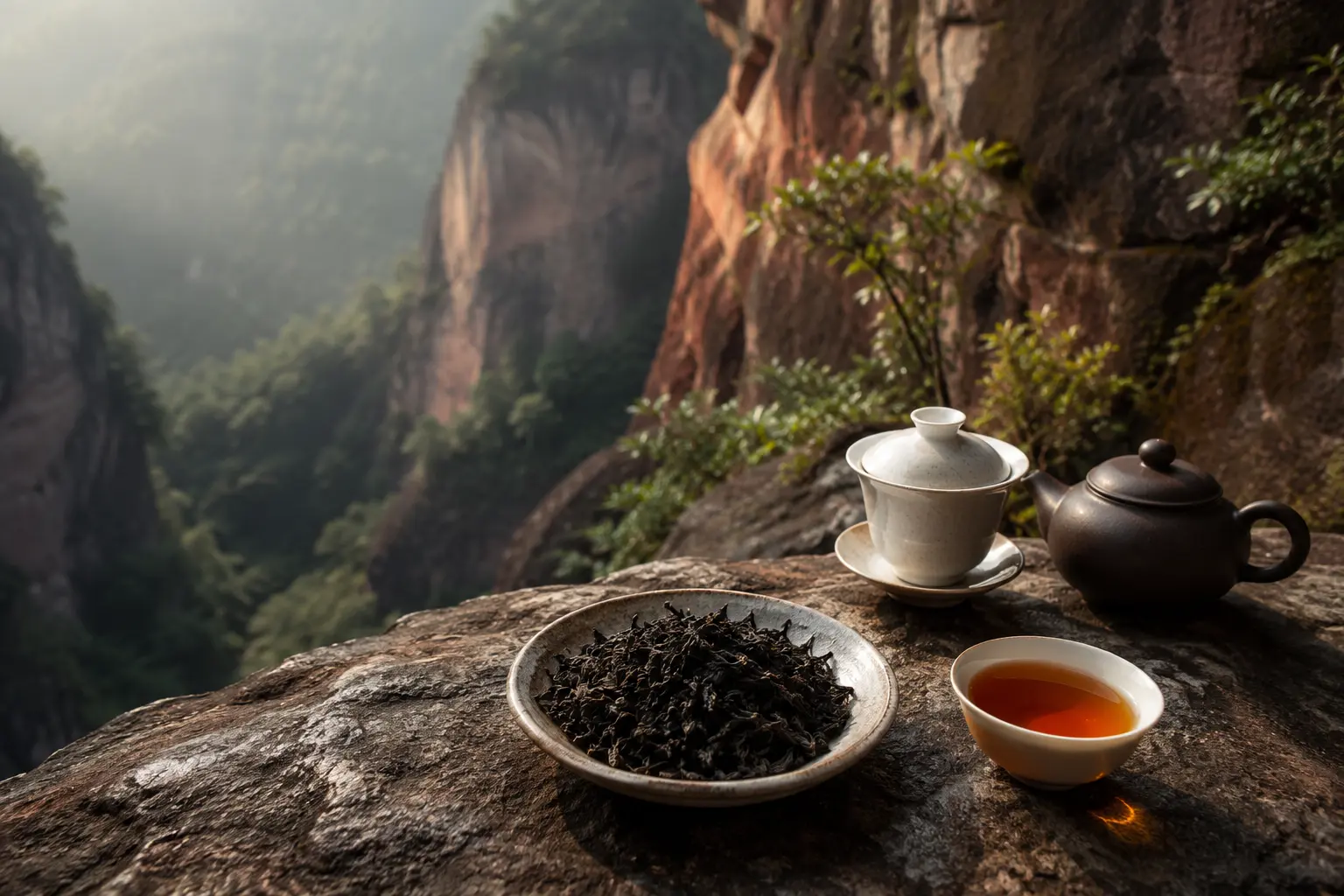
Yancha is defined by place and roast. It comes from the Wuyi mountains (武夷山) in northern Fujian — a UNESCO World Heritage site of dramatic red danxia cliffs, where tea bushes grow in pockets of mineral-rich, rocky soil between sheer rock faces. That terroir, combined with a traditional charcoal roast, gives the tea its character: a twisted dark leaf, a warm roasted aroma, and beneath it all a stony minerality.
In the oolong family, yancha sits at the medium-to-high oxidation, charcoal- roasted end — the opposite pole from a fresh green Tieguanyin. Where rolled green oolongs are floral and bright, rock oolongs are woody, roasted, and deep. They are autumn-and-firelight teas: complex, warming, and built to last across a long brewing session.
Yan yun: the rock rhyme
Ask any yancha drinker what they’re chasing and the answer is yan yun (岩韵), “rock rhyme” — the hallmark of true cliff-grown tea. It’s a mineral, almost stony sensation that runs beneath the roast and the aroma, lingering in the throat after you swallow. The classic four-character description is yan gu hua xiang (岩骨花香): “rock bone, flower fragrance” — a firm mineral backbone carrying floral and roasted notes on top.
Yan yun is easier to feel than to define, but once you’ve tasted a good zhengyan tea you recognize it: a depth and a mouth-coating, throat-cooling finish that thinner teas simply don’t have. It is the quality the whole grading system below is built to capture.
Terroir and grades: zhengyan, banyan, waishan
Because that mineral character is tied to the cliffs, where in Wuyi the tea grows drives both its flavor and its price. Tea is graded by terroir into a rough hierarchy:
| Grade | Chinese | Where it grows | Character |
|---|---|---|---|
| Zhengyan | 正岩 | The core scenic cliffs (the “three pits and two ravines”) | Deepest rock rhyme; most prized and priciest |
| Banyan | 半岩 | The outer hills and slopes | Lighter minerality, good value |
| Zhoucha / waishan | 洲茶 / 外山 | Riverside flats and outside the protected area | Softer, simpler, cheapest |
The most legendary plots are the “three pits and two ravines” (三坑两涧) — narrow, shaded ravines like Niulankeng and Huiyuankeng where the microclimate and mineral soil produce the most coveted tea. A Rou Gui from Niulankeng (“niurou”) commands eye-watering prices and is correspondingly faked. For a beginner the practical takeaway is simpler: zhengyan is the ideal, banyan is where most good everyday yancha lives, and a suspiciously cheap “core-cliff” tea almost certainly isn’t one.
The famous varieties
Yancha is made from many cultivars, but a handful dominate.
Da Hong Pao (大红袍)
The most famous name in rock tea, Da Hong Pao (“big red robe”) carries a legend — a scholar cured by the tea, an emperor’s red robes draped over the bushes in thanks. The original mother trees, a tiny cluster of centuries-old bushes on a Wuyi cliff, are now protected and have not been harvested since 2005. So here is the thing every beginner should know: the Da Hong Pao you can buy is never from those trees. It’s either grown from their cuttings (a purebred cultivar) or, far more commonly, a roaster’s blend of Wuyi cultivars composed to hit the classic Da Hong Pao profile. A good blended Da Hong Pao is a genuine, excellent tea — “Da Hong Pao” today names a style, not a single bush.
Rou Gui (肉桂)
Rou Gui (“cinnamon”) is the rising star of modern yancha — a cultivar named for the warm, spicy, cassia-like aroma it can develop under roast. Bold, aromatic, and assertive, it has become the tea serious drinkers chase by specific origin, with the ravine-grown Niulankeng Rou Gui (“niurou”) at the top of the heap.
Shui Xian (水仙)
Shui Xian (“narcissus”) is the workhorse and the comfort of the rock-tea world — a woody, orchid-scented, smooth and mellow tea, often the most approachable yancha for a newcomer. Its prize form is lao cong Shui Xian (老枞水仙), “old-bush” narcissus from decades-old plants, which adds a distinctive mossy, woody depth drinkers call cong wei.
The four famous bushes
Beyond these, tradition honors the si da ming cong (四大名枞), four celebrated heritage cultivars: Da Hong Pao, Tie Luo Han (iron arhat), Bai Ji Guan (white cockscomb, a pale, gentle outlier), and Shui Jin Gui (golden water turtle). They’re less common on shelves but worth trying when you find them.
Charcoal roasting and “fire”
If terroir is half of yancha, roasting is the other half. Traditional rock tea is baked over charcoal (炭焙) in repeated low, slow firings — a craft that can stretch over weeks and be revisited across years. Roasters speak in levels of “fire” (火功):
- Light fire (轻火) — keeps more of the green, floral high notes; fresher but less stable.
- Medium fire (中火) — the balanced middle, roasted warmth over preserved aroma; where much good yancha sits.
- Full / high fire (足火) — deep, dark, toasty and long, with the aroma folded into roasted sweetness; ages the best.
One crucial consequence: a freshly roasted tea needs to rest. Straight off the charcoal, yancha can taste sharp, dry, or “fiery”; over weeks and months the roast settles and integrates, a process called tui huo (褪火), “fire fading.” This is the single most common reason a rock oolong tastes harsh — it’s young. Give it a few months, or buy from a roast that has already rested.
How to brew Wuyi rock oolong
Yancha rewards the gongfu method, and it’s forgiving of heat in a way delicate teas aren’t.
- Use plenty of leaf. The twisted strips take up room — loosely fill a small gaiwan one-third to one-half full (roughly 7–8 g for a 110 ml gaiwan).
- Use fully boiling water, 100°C. Roasted rock tea wants real heat to open up; cooler water leaves it flat.
- Rinse once, a fast pour tipped straight out, to wake the roast and the leaf.
- Steep short and fast, especially early — just a few seconds for the first infusions, lengthening as it opens. Twisted leaf gives its flavor up quickly, so flash pours keep it from turning harsh.
- Keep going. A good yancha gives eight to ten infusions or more, the roast receding over the session to reveal the mineral rock rhyme underneath.
A gaiwan lets you taste the tea most honestly, but roasted oolong is also a classic match for a dedicated Yixing clay pot, whose porous clay is thought to round the roast and hold the heat these teas want.
Buying yancha without getting burned
A few habits steer you to good rock tea:
- Mind the rest. Ask whether the roast has settled; a tea roasted last month may need a few more to show its best.
- Be realistic about grade. Most great-value yancha is banyan, not core-cliff zhengyan. Treat cheap “Niulankeng” or mother-tree “Da Hong Pao” as marketing.
- Buy by cultivar and roast. A named Rou Gui or lao cong Shui Xian at a stated fire level tells you far more than a generic “rock tea.”
- Start with samples. A Shui Xian, a Rou Gui, and a blended Da Hong Pao side by side teach the family fast.
Where to start
If you’re new to rock tea, begin with a medium-fire Shui Xian — smooth, woody, and the gentlest way into the style — then try a Rou Gui for contrast and a blended Da Hong Pao for the classic profile. Brew them gongfu style, side by side, and the differences in aroma and rock rhyme will teach you more than any description.
From here you can step back to the broader oolong guide, nail the brewing fundamentals, or see where oolong sits among the six types of Chinese tea.
Sources & further reading
- Wuyi tea — rock oolong, varieties and terroir (Wikipedia)
- Da Hong Pao — the mother trees and the modern tea (Wikipedia)
- Oolong — oxidation, roasting and the oolong family (Wikipedia)
Researched and reviewed by the Cha Wisdom editorial team. We update our guides when the facts or our recommendations change.
Frequently asked questions
- What is Wuyi rock oolong (yancha)?
- Yancha, or rock tea, is a family of twisted, charcoal-roasted oolongs grown in the cliffs of the Wuyi mountains in northern Fujian, China. It's prized for yan yun, or 'rock rhyme' — a mineral depth said to come from the rocky soil — layered under a traditional charcoal roast. Da Hong Pao, Rou Gui and Shui Xian are the best-known kinds.
- What does 'rock rhyme' (yan yun) mean?
- Yan yun is the signature of good yancha: a mineral, almost stony quality that runs beneath the roast and lingers in the throat after you swallow. Drinkers describe it as 'rock bone, flower fragrance' — a firm mineral backbone carrying floral and roasted notes. It's considered the mark of true cliff-grown tea.
- Is Da Hong Pao the same as the famous mother trees?
- Almost never. The original Da Hong Pao mother bushes are a tiny, centuries-old cluster on a Wuyi cliff, protected and no longer harvested since 2005. Nearly all Da Hong Pao sold today is either grown from their cuttings or, more often, a roaster's blend of Wuyi cultivars made in the Da Hong Pao style.
- How do you brew Wuyi rock oolong?
- Brew it gongfu style: a lot of twisted leaf in a small gaiwan, fully boiling water (100°C), and fast pours. Rinse once to wake the roast, then steep short — just a few seconds early on — and add time each round. Good yancha gives eight to ten or more infusions.
- Why does my rock oolong taste sharp or ashy?
- It's probably freshly roasted and needs to rest. After charcoal roasting, yancha can taste sharp, dry or 'fiery' for weeks or months until the roast settles — a process called tui huo. Give a young roasted tea a few months in the cupboard, or buy from a roast that has already rested.
Keep reading
- How to Store Pu-erh Tea at Home for Aging
How to store pu-erh tea at home for aging: the right humidity, temperature and air, what to keep it in, mistakes to avoid, and how to spot mold.
- White Tea Guide: The Least Processed Chinese Tea
White tea explained: how the least processed Chinese tea is made, its grades from Silver Needle to Shou Mei, how it ages, and how to brew it well.
- Raw vs Ripe Pu-erh: What's the Difference?
Raw (sheng) vs ripe (shou) pu-erh, explained: how to tell them apart by color, aroma and taste, how each ages, and which one to drink first.