How to Store Pu-erh Tea at Home for Aging
How to store pu-erh tea at home for aging: the right humidity, temperature and air, what to keep it in, mistakes to avoid, and how to spot mold.
On this page
Pu-erh is the rare tea you can buy young and improve simply by keeping it well. But “keeping it well” is doing a lot of work in that sentence — storage is the single variable that makes or breaks aging, and the same cake can turn into something wonderful or something musty depending on the air around it. The good news: storing pu-erh at home is not complicated, and you don’t need a special room. This guide covers exactly what pu-erh needs, what to keep it in, what to avoid, and how to tell aging from trouble.
If you’re new to the tea itself, start with our pu-erh beginner’s guide and the difference between raw and ripe pu-erh — it’s raw (sheng) pu-erh that most rewards the patience below.
Why storage matters so much
Unlike a green tea, which is finished the day it’s dried, pu-erh leaves the maker alive — full of the enzymes and microbes that drive its slow transformation. Aging is that activity playing out over years, and like anything alive, it responds to its environment. Give it stable, moderate conditions and it deepens cleanly; let it get too damp and mold moves in; let it get too dry, too cold, or sealed up tight and it simply stops changing. You are not just keeping pu-erh — you are quietly hosting the process that improves it.
The ideal conditions
Pu-erh has five environmental needs, and they rarely conflict. Aim for the middle of each.
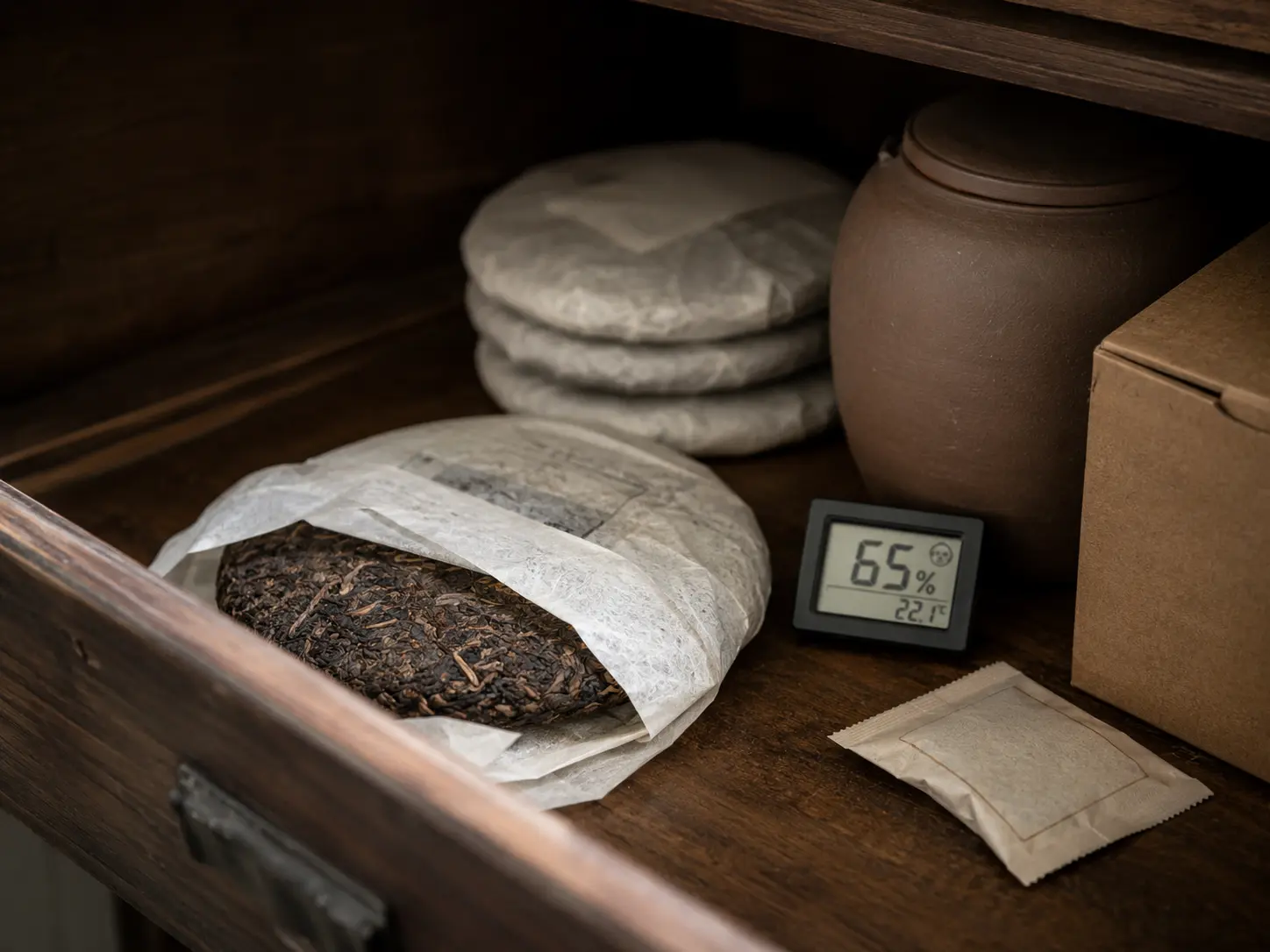
- Humidity — the big one. Roughly 60–70% relative humidity is the widely recommended target for clean home aging. Below about 50% the leaf dries out and transformation stalls; sustained above about 80% you’re inviting mold. A cheap hygrometer is the most useful tool you can own here.
- Temperature. Stable, ordinary room temperature — somewhere around 20–28°C is ideal. Warmth helps aging along; what really hurts is wild swings and extreme heat or cold, so an interior cupboard beats a sunny windowsill or an unheated garage.
- Air. Pu-erh needs to breathe a little. Gentle air exchange feeds the slow process; that’s why cakes are left in porous cotton-paper wrappers rather than vacuum-sealed. Stale, sealed, airless storage is for other teas, not this one.
- No odors. Pu-erh is a sponge for smells. Stored near coffee, spices, cleaning products, or a fragrant raw pu-erh next to a pungent ripe one, it will drink those aromas in. Keep it well away from the kitchen.
- No light. Direct sunlight and UV degrade tea and can heat it unevenly. Store it in the dark — a box, a cabinet, a drawer.
The enemies, in short, are the same as for any tea you want to keep — moisture, heat, light, oxygen in excess, and strong smells — just managed toward “stable and moderate” rather than “as little as possible.”
Dry storage vs wet storage
You’ll see these two terms a lot. Dry storage (the Taiwan and mainland norm today, and the right model for home) means clean, stable, moderate-humidity conditions that let pu-erh transform slowly and cleanly over many years. Wet storage is a traditional Hong Kong technique that uses deliberately high humidity and warmth to speed aging dramatically — it can mature a tea fast, but it walks a fine line, and done carelessly it produces musty, moldy cakes. For storing your own tea at home, aim squarely at clean dry storage. Wet storage is a professional’s gamble, not a beginner’s project.
What to keep pu-erh in
Match your container to your climate. The goal is breathable but protected.
- Leave cakes in their wrappers. The cotton paper a cake comes in is part of the system — it breathes while shielding the tea from light and casual odors. Don’t strip it off.
- A cardboard box or a dedicated drawer is enough for many homes: breathable, dark, and easy to keep away from the kitchen.
- Unglazed clay jars or pottery buffer humidity beautifully and look the part, a favorite of long-term agers.
- A “pumidor” — an airtight box or cabinet with a humidity pack (such as a 65–69% Boveda) and a hygrometer inside — is the answer in dry climates, where open storage would leave the tea too parched to age. It holds the moisture the air won’t.
Two more habits help: separate raw and ripe pu-erh (ripe’s earthy aroma can migrate into delicate raw cakes), and only break off what you’ll drink soon — leaving cakes whole and tuochas intact preserves them better than crumbling them into a tin.
A note on climate
Where you live decides your job. In a humid climate (much of southern China, or a muggy summer anywhere), your task is to prevent mold: favor ventilation, keep an eye on the hygrometer, and don’t let cakes sit in stagnant, over-damp air. In a dry climate (northern winters, arid regions), your task is the opposite — add and hold humidity with a sealed container and a humidity pack, or the tea will simply sit inert and never develop. Most homes fall between, and a breathable box in an interior closet does the job with little fuss.
Mistakes to avoid
Most ruined pu-erh comes from a short list of well-meant errors:
- The fridge or freezer. Right for green tea, wrong for pu-erh — cold stops the aging you’re paying for and invites condensation.
- Vacuum-sealing or mylar for the long term. Airtight kills the slow breathing pu-erh needs. (Sealed-with-a-humidity-pack is different, and only for dry climates.)
- Storing it in the kitchen. The single most common way to end up with curry-scented tea.
- Chasing damp for speed. Trying to rush aging with high humidity is how beginners grow mold. Slow and clean beats fast and risky.
- Fussing constantly. Pu-erh likes to be left alone. Check it occasionally; you don’t need to unwrap and handle it every week.
Mold, or just “tea frost”?
This worries beginners, so it’s worth being clear — and a little cautious, since this is about what goes in your cup. What drinkers call tea frost — a fine, flat, whitish crystalline bloom that can appear on well-aged leaves — may be harmless, but it’s easy to mistake for mold, so don’t guess. Mold is fuzzy, often green, blue, white-furry, or black, and it comes with a musty, sour, or sharply off smell. Frost wipes into the leaf and stays put; fuzzy growth and a wet, moldy odor mean the tea took on too much moisture. If you see fuzzy growth, smell that damp-basement note, or simply aren’t sure, don’t drink it — and check whether your storage has crept too humid.
Be patient — and realistic
Home aging is a long game, and an honest one. In a temperate or dry climate, a raw cake transforms slowly — meaningful change is measured in years, not months, and you may not taste a dramatic difference for a long time. That’s normal, not failure. Buy tea you already enjoy young, store it well, and treat any improvement as a bonus rather than a guarantee. Ripe pu-erh, already mellow, asks even less of you: a year or two of clean rest is plenty.
The reassuring truth is that pu-erh is forgiving of neglect far more than of meddling. Wrap it, box it, keep it dark, stable, and away from the kitchen, glance at a hygrometer now and then, and time does the rest.
The short version
Store pu-erh at stable room temperature, around 60–70% humidity, in the dark, with a little airflow, far from strong smells — and leave it largely alone. Keep cakes in their wrappers inside a breathable box or clay jar; reach for a sealed pumidor only if your climate is very dry. Skip the fridge, skip airtight bags, and keep it out of the kitchen. Do that, and a young cake you like today can quietly become a better one years from now.
From here, brush up on brewing pu-erh well, explore raw vs ripe, or see how the other great ager, white tea, keeps under similar — but drier — conditions.
Sources & further reading
- Pu’er tea — aging, dry vs wet storage and production (Wikipedia)
- Tea processing — fermentation and post-fermentation (Wikipedia)
- Relative humidity — the measure your hygrometer reads (Wikipedia)
Researched and reviewed by the Cha Wisdom editorial team. Storage ranges reflect common practice among pu-erh drinkers and are starting points, not guarantees; we update our guides when the facts or our recommendations change.
Frequently asked questions
- What humidity is best for storing pu-erh?
- For clean home aging, aim for roughly 60–70% relative humidity at a stable room temperature. Below about 50% the tea dries out and aging slows to a crawl; sustained above about 80% the risk of mold climbs sharply. A small hygrometer takes the guesswork out, and in dry climates a humidity pack in a sealed box (a 'pumidor') holds the range steady.
- Can I store pu-erh tea in the fridge or freezer?
- No. Cold storage is for preserving delicate green tea, but pu-erh is meant to keep transforming, and that slow change needs ordinary warmth and air. Refrigerating it stalls the aging you want and risks condensation and absorbed food odors. Keep pu-erh at stable room temperature instead.
- Should pu-erh be kept airtight?
- Not for long-term aging — pu-erh needs to breathe a little, so it's traditionally left in its cotton-paper wrapper and a breathable box rather than vacuum-sealed. The exception is a very dry climate, where a sealed container with a humidity pack is used to hold moisture in. Either way, protect it from strong smells, which it readily absorbs.
- How can I tell if my pu-erh has gone moldy?
- Real mold is fuzzy, often green, blue or black, and smells musty, sour, or sharply off. What some drinkers call 'tea frost' — a fine, flat, crystalline bloom on aged leaves — may be harmless, but it's easy to confuse with mold. If the growth is fuzzy, smells musty, or you're unsure, don't drink it; it means the tea took on too much moisture.
- Does ripe pu-erh need aging too?
- Ripe (shou) pu-erh is mostly drink-ready and gains less from age than raw (sheng), though a few years of rest does smooth it and clear any leftover 'wet-pile' note. Raw pu-erh is the real candidate for long aging. Store both the same way; just expect the patience to pay off most with raw.
Keep reading
- White Tea Guide: The Least Processed Chinese Tea
White tea explained: how the least processed Chinese tea is made, its grades from Silver Needle to Shou Mei, how it ages, and how to brew it well.
- Raw vs Ripe Pu-erh: What's the Difference?
Raw (sheng) vs ripe (shou) pu-erh, explained: how to tell them apart by color, aroma and taste, how each ages, and which one to drink first.
- Wuyi Rock Oolong (Yancha): A Complete Guide
Wuyi rock oolong, or yancha, explained: rock rhyme, cliff-grown terroir, Da Hong Pao, Rou Gui and Shui Xian, charcoal roasting, and how to brew it.